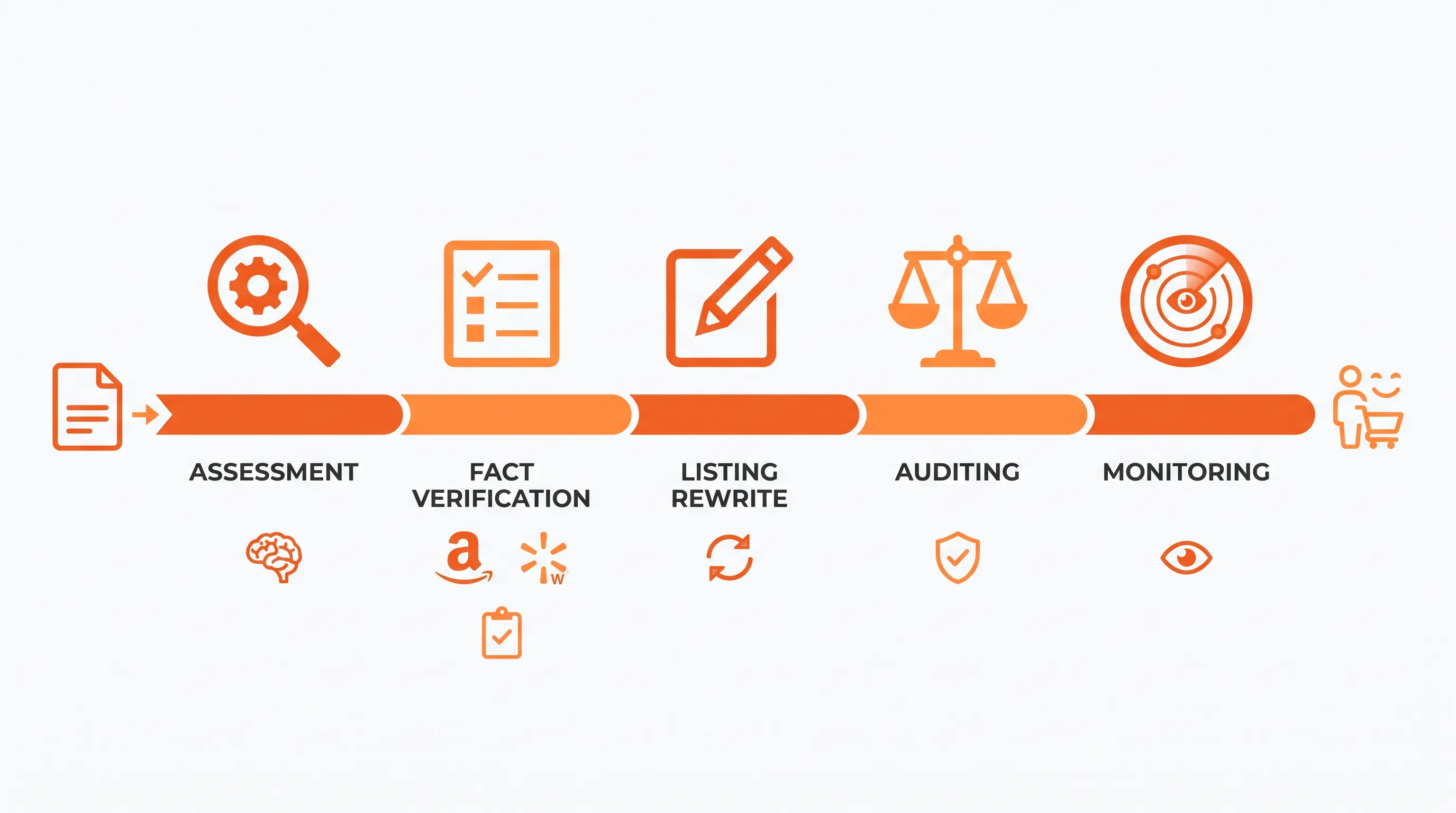
Why AI is reshaping marketing stacks
Marketing operations have changed faster in the last two years than in the previous decade. The work of researching keywords, drafting briefs, testing ad creative, and modeling attribution used to be handled by separate teams running separate tools on separate timelines. That sequence has collapsed. Buyers now ask ChatGPT for recommendations before they ever visit a website, and the AI online marketing tools a team picks today decide whether the brand shows up in those answers at all.
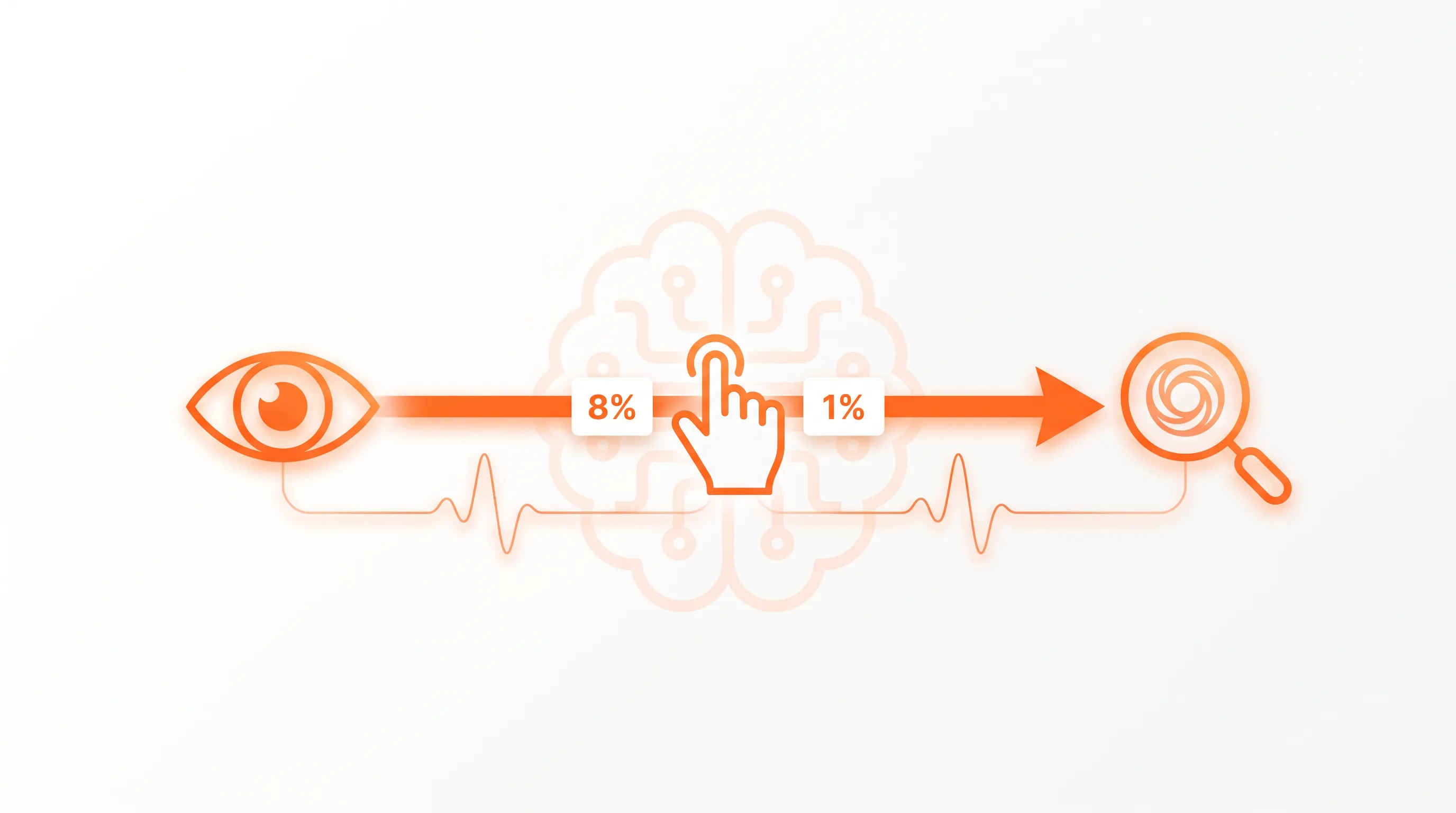
The shift is measurable. Pixis reports that 69.1% of marketers have already integrated AI into their workflows, up from 61.4% a year earlier. On the search side, Seer Interactive found that organic click-through rate dropped 61% on queries where Google AI Overviews appear. Traffic is being intercepted before the click.
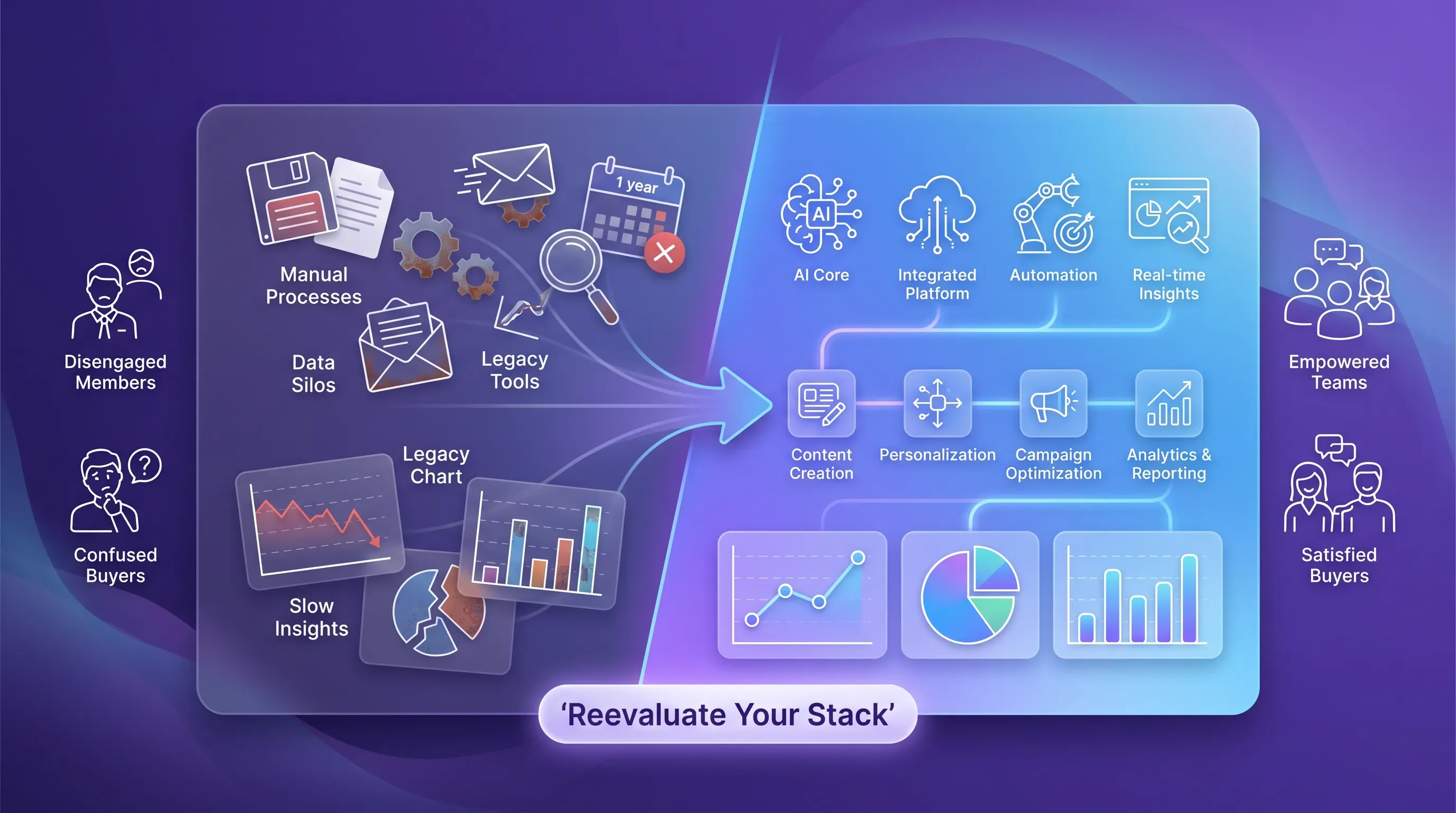
That's why teams are reevaluating their stack right now. The old toolbox was built for ten blue links and a linear funnel. Neither is how buyers behave anymore. The stakes are concrete: pick the wrong AI online marketing tools and you spend a year producing content nobody cites and reporting on dashboards that contradict each other.

Best AI online marketing tools by category
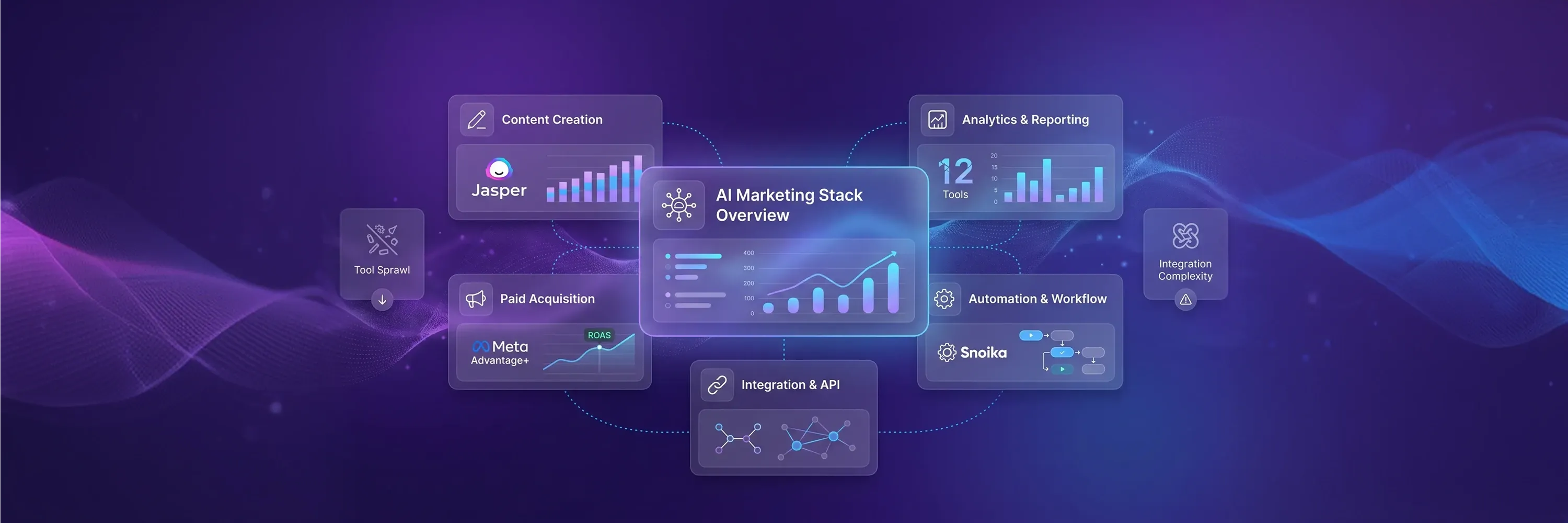
The AI online marketing tools market is crowded, but the categories underneath it are clear. Most teams need coverage across five functions: search visibility, content production, paid acquisition, analytics, and workflow automation. The right way to evaluate options is to start from the business problem each category solves.
AI tools for search and visibility
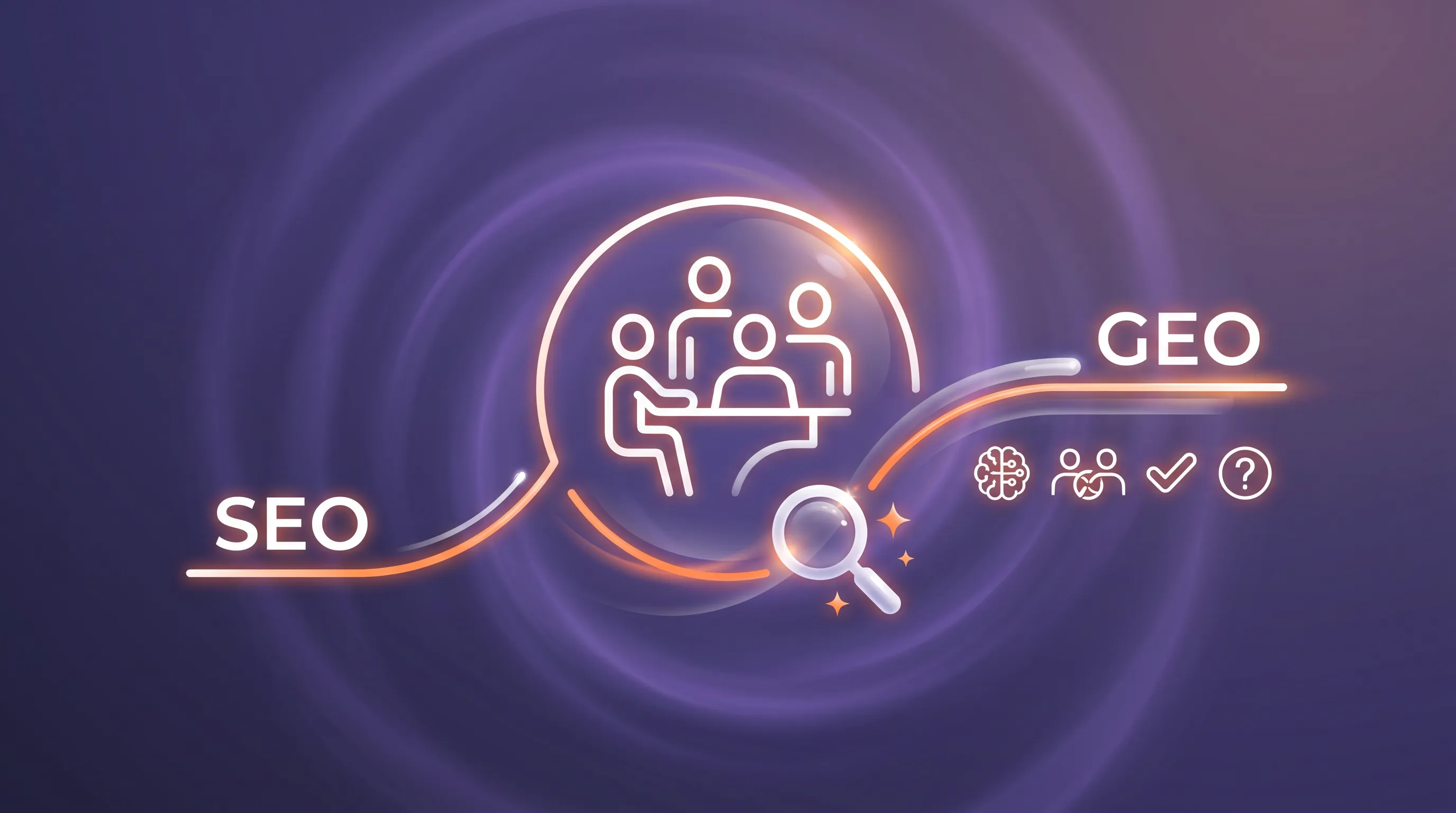
This is the newest category, and the one where traditional online marketing software falls shortest. Tools like Semrush and Ahrefs were built to track ranking positions in Google's ten blue links. They weren't built to track whether ChatGPT recommends your product when a buyer asks for the best CRM, or whether Perplexity cites your documentation when a developer asks how to integrate an API.
Yext analyzed 6.8 million AI citations across major AI answer engines and found that each model sources answers differently. ChatGPT leans heavily on third-party directories. Perplexity favors niche industry sources. Google AI Overviews pull 99% of citations from the organic top ten. A single ranking score can't capture any of that.
The AI online marketing tools built for this layer track something different: how often your brand is mentioned, plus the context and competitors attached to those mentions. Tools such as Otterly and Profound run defined prompts across the major models and report citation share over time. Yext Scout takes a location-first approach for multi-site brands. What to look for when evaluating them:
-
Coverage across at least ChatGPT, Perplexity, Google AI Overviews, and Claude
-
Prompt volume large enough to produce a stable baseline rather than a sample
-
Competitive share-of-voice reporting across competitors
-
Content recommendations tied to the prompts where you're losing
AI tools for content creation
Content tools split into two camps. Generation platforms like Jasper and Copy.ai are built for speed and scale. They produce blog drafts and email copy with brand voice controls. Jasper holds a 4.8/5 rating on G2 from more than 1,200 reviewers and is priced around $69 per seat per month, with strength in long-form work and brand consistency. Copy.ai sits at a similar rating with stronger automation around go-to-market workflows.
Optimization platforms are a different category. Surfer SEO scores drafts against the top-ranking pages for a keyword and recommends term coverage and structure. It pairs well with a generation tool because pure generators don't know what's already ranking for the query you're writing about. Frase and Clearscope occupy the same optimization slot with different angles on competitive analysis.
The boundary matters because buying both a generator and an optimizer is the default path, and it's how content stacks balloon. Teams that try to write directly inside an optimizer find the prose stiff. Teams that publish straight from a generator find the rankings weak. The interesting question is whether your online marketing software can handle generation and optimization in the same draft without exporting between products.
AI online marketing software for ads and acquisition
Paid acquisition is the area where AI moved from assistant to operator. Meta Advantage+ is the clearest example. Meta reports that brands using Advantage+ shopping campaigns saw a 15% higher ROAS and 12% lower cost per action versus manually structured campaigns. Coinis reports an average return of $4.52 per dollar spent on Advantage+, roughly 22% higher than standard campaigns.
Google Performance Max and TikTok Smart Performance Campaigns run on the same principle. The advertiser supplies creative assets and a conversion goal, with audience signals as guidance. The platform decides placement and creative combination in real time, with bidding handled inside the same system. Campaign structure flattens. Creative volume matters more than audience segmentation, because the algorithm runs the segmentation itself.
That shift changes the role of online marketing software in this category. Tools like AdCreative.ai and Smartly.io now sit upstream of the ad platforms and create ad variants at scale to feed the algorithms. The team's job becomes producing inputs and reading aggregate signals rather than micromanaging ad sets. Evaluate options on creative output volume and brand safety controls, plus how cleanly the tool hands assets to major ad platforms without manual rework.
AI analytics and attribution tools
As paid channels became more automated and cookies less reliable, attribution got harder. The category fills that gap. Northbeam and Triple Whale focus on direct-to-consumer brands that run Meta and TikTok, and their machine learning models assign credit across touchpoints after iOS limited deterministic tracking. Dreamdata and HockeyStack are built for B2B journeys, where the path from first touch to closed deal can run six months across a dozen interactions.
The risk in this category is dashboards with AI labels pretending to be AI analytics. The real AI online marketing tools do three things that pure reporting tools can't. They model what would have happened without a given campaign, which the CMO Alliance describes as the core of incrementality testing. They predict campaign outcomes before you spend. And they surface the touchpoints driving revenue rather than waiting for you to ask the right question.
The selection criteria are practical. Check how the platform handles your conversion windows. Ask whether the model is documented or a black box. Make sure the tool ingests data from every channel you actually run, because an attribution model with blind spots is worse than a last-click report that admits its limits.
AI growth tools for automation and workflows
AI online marketing tools for growth sit between the categories above and connect actions across channels. Clay has become the dominant name in outbound enrichment because it builds waterfalls of data sources to find the right contact and opener for each account, based on the relevant account signal. HubSpot Smart CRM bundles lifecycle automation with the underlying contact database. Customer.io specializes in behavioral messaging and processes millions of product events per day to trigger email, SMS, push, and in-app messages.
These growth tools speed up execution because they remove the handoffs that used to live between teams. A funding signal from Crunchbase can write back to HubSpot, trigger an enrichment in Clay, generate a personalized opener, and push the contact into a Smartlead sequence without anyone touching a spreadsheet. LeadHaste documented that exact workflow connecting six tools into one outbound motion.
The overlap with other categories is where the trouble starts. Customer.io overlaps with HubSpot on lifecycle email. Clay overlaps with most attribution tools on contact-level data. Many growth tools overlap with content platforms on personalization. Teams that buy each one separately discover the integration cost later.
The hidden cost of tool sprawl
The Pedowitz Group puts the typical B2B marketing team at 25 to 60 tools, with a common middle around 35 to 45. Gartner's 2025 Marketing Technology Survey, cited by Logarithmic, found the average enterprise marketing organization now operates 91 distinct tools, up from 68 three years prior. Only 33% of those capabilities are fully used. The rest is paid-for and ignored.
The license fees are the easy part to see. The harder costs show up everywhere else. Data lives in different schemas across each platform, so the revenue number in HubSpot doesn't match the revenue number in the attribution tool, and neither matches what the finance team sees. Marketing Mary's analysis puts the weekly time lost to tool management at more than eight hours per marketer.
Integration complexity scales worse than the headcount. A stack of ten tools has up to 45 possible pairwise integrations. A stack of twenty has 190. At ninety tools the number runs past four thousand. Most teams don't integrate everything, but every new tool adds maintenance work that lands on whoever is closest to the wiring, which on small teams is the same marketer who's supposed to be running campaigns.
The operational symptoms are familiar to anyone who's lived through a quarterly review. The content team writes briefs the SEO team doesn't see. The paid team optimizes campaigns the analytics team can't attribute. Two leaders argue about which dashboard tells the truth, and the meeting ends without a decision. Sprawl slows execution because no single tool sees the whole picture.
What to look for in a unified stack
Consolidation reduces the number of places where the same data has to be re-entered or reconciled. Four questions separate a genuinely unified platform from a bundle of acquired products with a shared logo.
-
Does the platform run on a shared data layer, or does each module keep its own copy? If the content tool and the analytics tool don't agree on what a session is, you've bought two products and one problem.
-
Does the workflow go from insight to execution inside the same product? A platform that surfaces an AI visibility gap but makes you export a CSV to fix it has solved half the problem.
-
Is the AI native or bolted on? Vendors added "AI" to product pages faster than they rebuilt the underlying systems. Ask what the model actually does and what happens when it's wrong.
-
Does the pricing scale with use, or does every new seat trigger a renegotiation? Growth tools that punish growth defeat their own purpose.
Apply these questions to every vendor on a shortlist. The answers separate platforms designed to consolidate from platforms designed to upsell.
How Snoika unifies AI marketing in one workflow
Snoika is built around the four criteria above. It handles AI search visibility and content optimization inside one workflow with shared data. Growth execution uses the same workflow, which is why it replaces several of the point tools described earlier rather than sitting alongside them.
The visibility layer tracks brand citations across ChatGPT, Perplexity, Google AI Overviews, and Claude, then connects each gap to the content that would close it. The content layer handles drafting and optimization in the same editor, so writers aren't bouncing between a generator and a scoring tool. The growth layer pushes briefs and campaign assets out to the channels where they run.
The practical result is fewer subscriptions and one reporting surface, with a tighter loop between seeing a problem and acting on it. A team that today runs an AI visibility tracker, a content generator, a content optimizer, and a separate analytics dashboard can fold those functions into Snoika and reclaim the integration work that used to live between them. That's the case for it in plain terms. It's a way to stop buying the same capability twice.
Choosing the right stack for your business
The right stack depends on stage. Early-stage founders who run their own marketing get more from one consolidated platform for AI online marketing tools than from a shortlist of best-in-class tools they don't have time to integrate. Growth-stage teams between Series A and C run 10 to 20 tools and benefit most from cutting overlap, particularly in content and analytics where duplication is highest. Established brands at enterprise scale will keep specialist tools in some categories, but even there, consolidation around AI search visibility and content production removes a meaningful chunk of the maintenance work.
A short checklist before you buy anything new:
-
List every tool currently in use and the function it covers
-
Mark overlaps where two tools do the same job
-
Identify gaps in AI search visibility, because that's where most stacks are still empty
-
Ask whether your next purchase consolidates the stack or adds to it
If the answer to the last question is "adds," think twice. The best AI online marketing tools today are the ones that let you cancel two subscriptions for every one you sign. To audit your current setup or see how a unified workflow looks in practice, try Snoika or book a walkthrough with the team.
Conclusion
The market for AI online marketing tools will keep expanding, and most teams will keep buying faster than they consolidate. That's the pattern Gartner has tracked for a decade and the pattern that produces 91-tool stacks with 33% utilization. The teams that win the next cycle will be the ones who picked a small set of AI online marketing tools that share data and execute without handoffs across the new search surfaces. Snoika is built for that decision. Audit your stack, then see what one workflow can do.