
Real estate SEO for AI search
When buyers ask ChatGPT which agency to use in a neighborhood, they get back a paragraph that names two or three firms. Snoika's real estate SEO for AI search gets your brokerage or development into that paragraph, with listings and area guides that assistants trust enough to cite. We start by finding out who the assistants name in your market today. Our free AI visibility report shows that, along with the prompts where your name is missing.
Real estate SEO for AI
Real estate SEO for AI means getting your agency named and cited inside ChatGPT and Google AI Overviews answers, on top of ranking in the usual blue links. BrightLocal's 2026 Local Consumer Review Survey found that 45% of consumers use ChatGPT or similar tools for local business recommendations, up from 6% a year earlier. Pew Research Center found that Google users who saw an AI summary clicked a result in only 8% of visits, against 15% when no summary appeared.
So a listing page can rank well and still get fewer enquiries. Your analytics won't show the conversations where a rival was named and you weren't, which is why we measure the answers themselves.
Real estate SEO for AI means getting your agency named and cited inside ChatGPT and Google AI Overviews answers, on top of ranking in the usual blue links.
How assistants pick agents
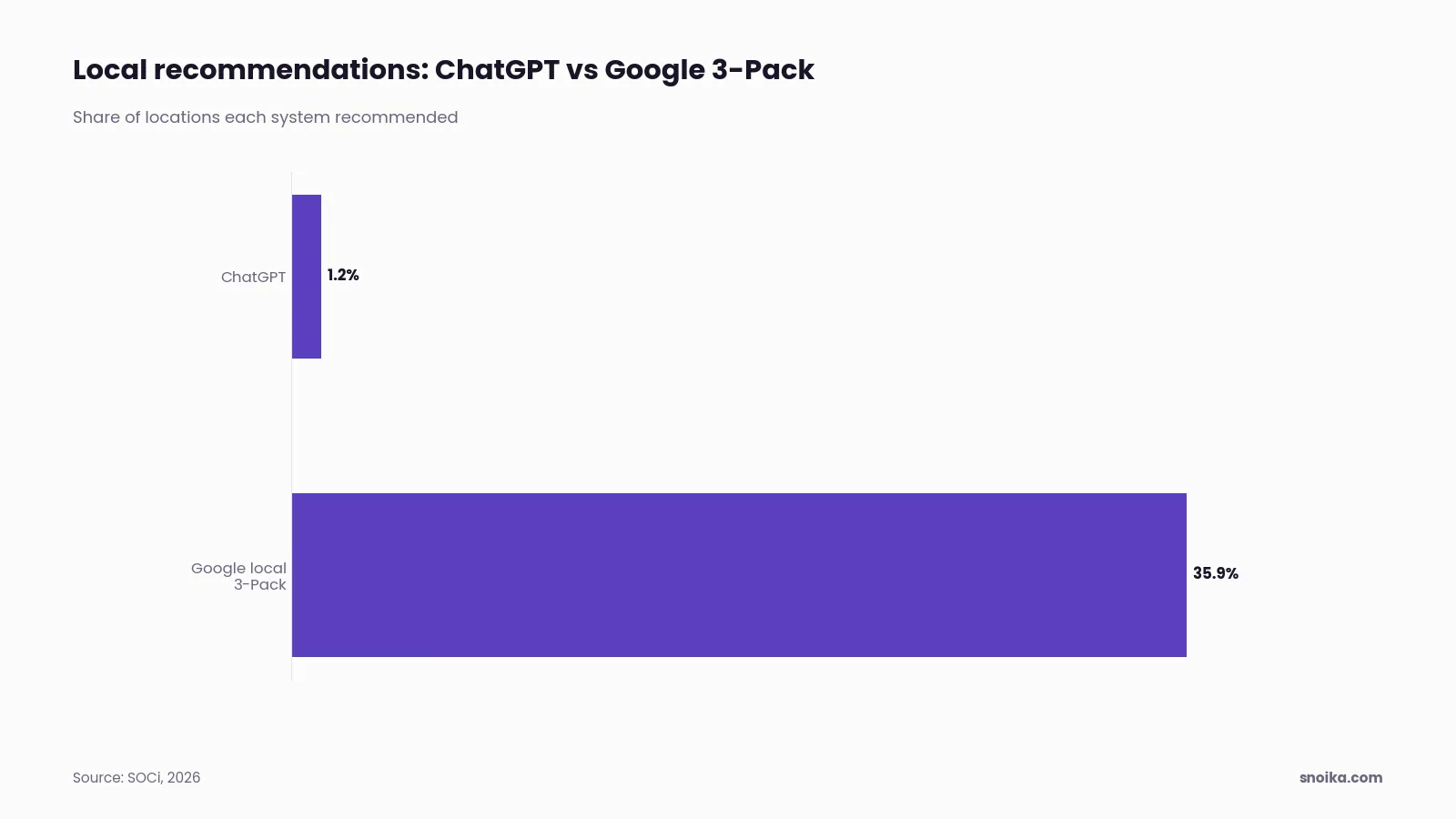
No single agency ranks best for AI search in every market. The firm an assistant names depends on the exact prompt and the city, where the model trusts particular sources. SOCi's 2026 Local Visibility Index found ChatGPT recommended just 1.2% of locations, compared with a 35.9% rate of appearing in Google's local 3-Pack. The businesses it did recommend averaged 4.3 stars.
In BrightLocal's analysis, business websites made up 58% of ChatGPT's local sources, and mentions on other sites and directories made up the rest. To find out who leads in your market, we run 20 to 30 prompts your buyers would actually type, in each city you cover, and record every agency named. That baseline covers each language you sell in too, because assistants answer differently in each market.
Area guides that win citations
A property developer gets cited by ChatGPT when its site gives the most specific answer to the neighborhood question a buyer asks, and when other sites back that answer up. A paragraph calling the area "vibrant" gives a model nothing to quote. The area guides we write carry facts it can lift:
Commute times
How long the trip takes by tram and by car.
School catchments
The boundaries that decide which schools a home falls under.
Dated area figures
Price-per-square-meter figures with the date they were measured.
Planning status
Where local planning applications stand.
Pew examined Wikipedia alongside the platforms YouTube and Reddit and found that these sites together supplied 15% of sources in Google's AI summaries. So a developer also needs coverage in local press and forums that repeats its facts, which our off-site work goes after. To comply with fair housing and advertising rules, our guides describe the place itself and avoid descriptions of the kind of buyer it supposedly suits.
Listing content AI surfaces
Your listings show up in AI answers when the page on your own domain has facts a model can quote and stays live long enough to be crawled and cited. When units sell and their pages get delisted, the work you put into a listing disappears with the listing. Portal syndication causes a second problem, because the aggregator's copy gets indexed first and takes the credit.
We put each description on your own site before it feeds the portals, written differently from the portal version. When a unit sells, the page stays live as a sold record with its price history, or redirects to the matching area guide. NAR data shows that in 2024, 43% of buyers started their search by looking online.
Your listings show up in AI answers when the page on your own domain has facts a model can quote and stays live long enough to be crawled and cited.
Local signals behind recommendations
Google's AI features draw on the same local signals as its map results. According to Google Business Profile Help, local results depend mainly on how well a profile matches the search and how far the business is from the searcher. A third factor, prominence, measures how well known the business is, which Google estimates from links and reviews. Your distance from a searcher is fixed, so we focus on the signals below.
Is your Business Profile complete?
The profile needs the exact category, such as real estate agency, and one location page for each office. It should describe the areas you serve in plain words with specific neighborhood names. A thin profile tells Google too little to match it to a specific question.
The profile needs the exact category, such as real estate agency, and one location page for each office.
How recent are your reviews?
The number of reviews counts, and so does how recent they are. Ask for a review at closing, while the buyer still remembers the agent's name. Then reply to each one, and name the neighborhood in your reply when it fits.
The number of reviews counts, and so does how recent they are.
Which other sites mention you?
Directory listings and local news coverage tell a model that people outside your company know who you are. Your name, address and phone number should read the same on every one of those sites.
Directory listings and local news coverage tell a model that people outside your company know who you are.
Where classic SEO falls short
Classic SEO reports on rankings and clicks, and neither number tells you whether an assistant named your agency. Our SEO solutions for property measure assistant answers and produce the content plan that changes them, from one team. A single-office agent in a small town can get far with a complete profile and steady reviews, while developers who sell across borders need answers measured and content mapped and published in every market.
Classic SEO reports on rankings and clicks, and neither number tells you whether an assistant named your agency.
Snoika for property businesses
For property businesses, Snoika runs the full service from audit to reporting:
Audit
We review your site and track your AI visibility in ChatGPT and Google AI Overviews.
Content map
A researched content map sets which area guides and listing support pages come first.
Content
We write in 135+ languages and regional variants, which matters when your buyers ask in German or Mandarin about a Lisbon apartment.
Publishing
Pages go live on your own domain through a DNS connection, your existing site stays in place, and you approve every page in the dashboard first.
Human review
A review layer checks the automated output before anything is published.
Off-site work
Off-site strategies and reporting with lead tracking complete the service.
Onboarding starts with your market, your buyers and your goals, and then we connect GA4, Google Search Console and Google Tag Manager. Our published results so far come from other industries.
Measuring AI visibility gains
You measure AI visibility by running the same prompt set every week and recording who gets named. Snoika records brand mentions and share of voice in ChatGPT and Google AI Overviews, along with sentiment and citations. We keep branded prompts apart from unbranded ones, so people searching your agency's name don't inflate the numbers.
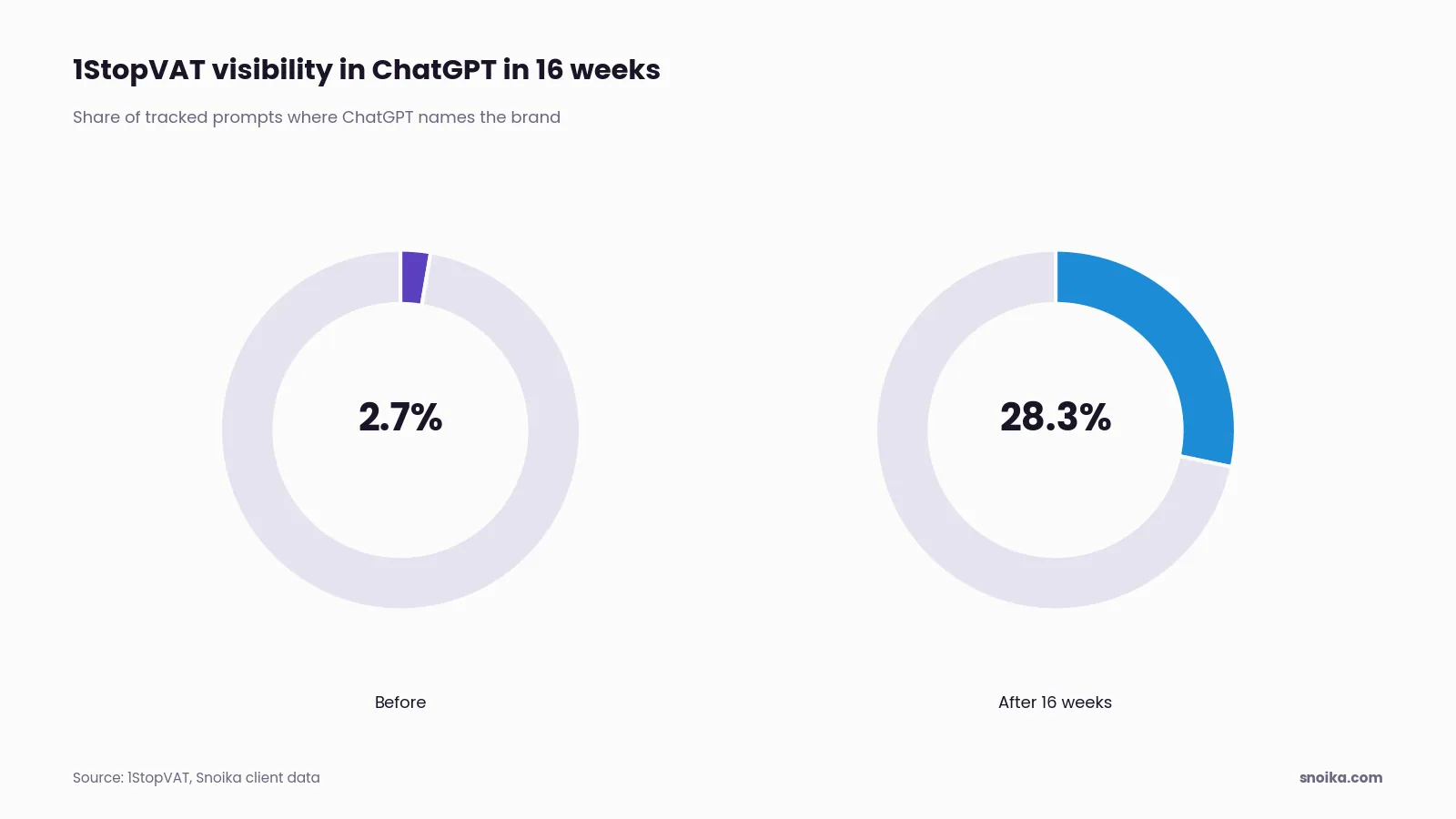
The trend matters more than any single week's result. Snoika's founder Anton Vedeshin reported to Startup Reporter 1StopVAT's move from 2.7% to 28.3% ChatGPT visibility in 16 weeks. Search Console counts AI Overviews traffic within the "Web" search type, so a rise in impressions next to flat clicks tells you something real.
Schema assistants read
The schema type built for property is RealEstateListing. It describes the listing, while nested types describe the property and the offer. We fill in datePosted on every listing and add leaseLength for rentals.
Google's guide to generative AI features says structured data "isn't required for generative AI search" and that you don't need any special markup. It still recommends structured data because it qualifies pages for rich results. We mark up only what a visitor can see on the page and check the result in Google's Rich Results Test before it goes live.
The schema type built for property is RealEstateListing.
Trusted by

























FAQ
There's no single leading agency across all AI searches, because recommendations depend on the question and location. We test 20 to 30 realistic buyer questions for each city you cover, record every agency named, and compare repeated appearances rather than one answer.
We publish neighborhood guides that answer specific buyer questions with dated facts, such as commute times and local planning applications, and back them with coverage on other sites. The guides describe the location rather than the type of buyer it suits, which supports fair housing compliance.
We give assistants listing pages on your own website with specific facts they can cite, published before the portal versions and written differently. After a sale, the page stays live as a sold record with price history or redirects to the matching area guide.
Google AI draws on local search signals, including relevance, distance and prominence, which Google estimates from links and reviews. We make sure your Business Profile is specific to your office and service areas, and that your business details match across directories.
We don't promise a fixed timeline for real estate SEO results. We track the same buyer questions weekly, with branded searches kept separate from unbranded ones, so you can see the trend from your first baseline.
See how AI talks about your brand