Build authority signals
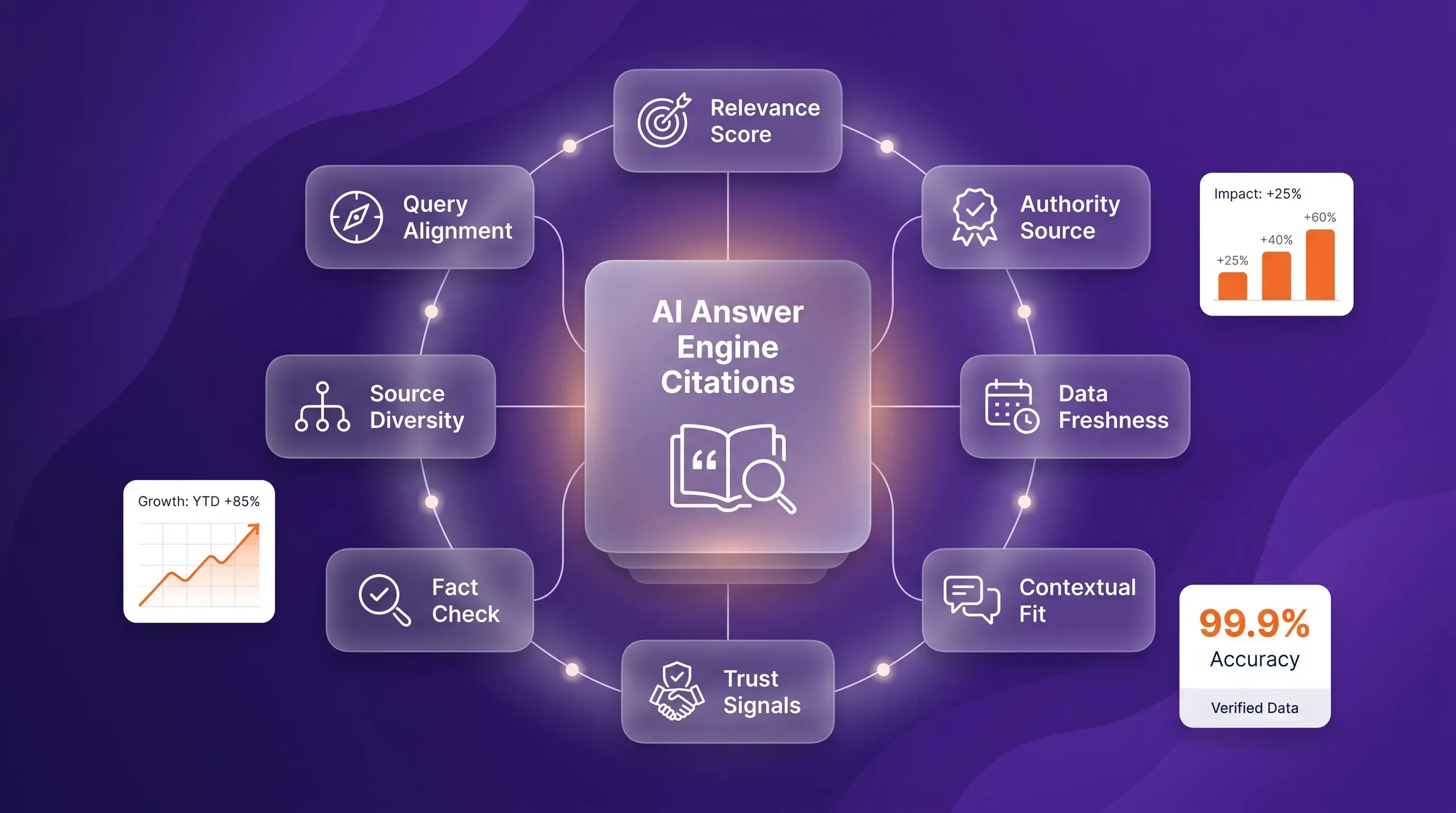
Engines triangulate which brands to name by reading signals beyond your own site. Consistent entity information across your presence tells a model that the "Acme" on your homepage and your LinkedIn are one entity, which makes you safe to cite. Inconsistent names or descriptions leave that identity undefined and weaken your odds.
Third-party references do the heavy lifting here, and the kind matters more than the volume. A mention in an industry publication or a respected community thread carries weight because it confirms your relevance from outside your own marketing. Srinivas has been blunt about why citations exist in the first place: they keep AI answers from drifting into "confident-sounding opinion," and the system leans on domains people already trust. Your job is to be one of those domains in your niche.
Focus on references that establish you as a subject authority, like coverage of your category or a forum where practitioners trade recommendations. Those are the mentions an engine reads when it decides who to name.
Publish original data
Proprietary numbers get quoted because nobody else has them. When an engine assembles an answer that needs a statistic, a first-hand survey result or an internal benchmark is the cleanest thing to cite, since it comes from a single attributable owner. A rephrased industry stat that appears on forty sites gives the engine no reason to name you specifically.
Package the data so attribution is unavoidable. State the finding in one sentence and attach your brand to it with the sample and date so the claim reads as verifiable. "In our 2024 survey of 800 marketing leaders, 41% reported cutting their blog cadence" is far easier to lift and credit than a vague gesture at a trend. The structured framing matters as much as the number, because schema and clear labeling help engines parse your facts. Ahrefs found AI-cited pages were almost three times more likely to carry JSON-LD than non-cited pages, though their follow-up test showed adding schema alone moved nothing without strong content underneath it.
That caveat is the lesson. Original data is the asset. Clean structure and labeling make an undefined finding easier to retrieve, but the proprietary finding is what earns the citation in the first place.
Measure your ai visibility
Clicks no longer tell you the whole story, so you need a way to prove whether you're being named. The metric that matters now is presence inside answers: how often your brand appears and how that trend moves over time across the major engines.
The workflow is straightforward to set up and run on a regular cadence:
-
Build a list of the prompts your buyers actually ask, such as category questions and "best tool for X" phrasings where you want to be named.
-
Run those prompts across your target answer engines on a fixed schedule, and record whether you appear and which competitors show up beside you.
-
Track two numbers over time: your coverage rate, which is the share of prompts where you appear, and your share of voice against named competitors.
Dedicated tools handle the repetition. Otterly.AI, used by more than 20,000 marketing professionals, sends your prompts to these engines automatically and reports brand coverage and share of voice. Frase and Profound do comparable work, so the choice depends on how many engines you need and how deep the competitive breakdown has to go.
Set realistic expectations about the noise. The same prompt can return different sources on different days, since retrieval and model updates shift outputs. Attribution is incomplete too, because a brand mention without a link is undefined in referral analytics, yet still shapes what a buyer believes. Watch the trend across many prompts over weeks before you react to any single answer. Direction is the signal. One snapshot is noise.
Where to start this week
Pick your ten highest-intent prompts and run them across ChatGPT and AI Overviews to set a baseline. Then take the three pages already ranking for those queries and rewrite their openings into direct, brand-named answers. After that, package one proprietary stat with a clear label and date so it's ready to be quoted.
This ongoing discipline keeps pace with retrieval shifts as models and engines update. The teams gaining ground are the ones treating AI visibility and citation optimization as a standing practice. Start with those undefined moves this week and use a two-week measurement check to keep refining the pages that earn you a place inside the answer.