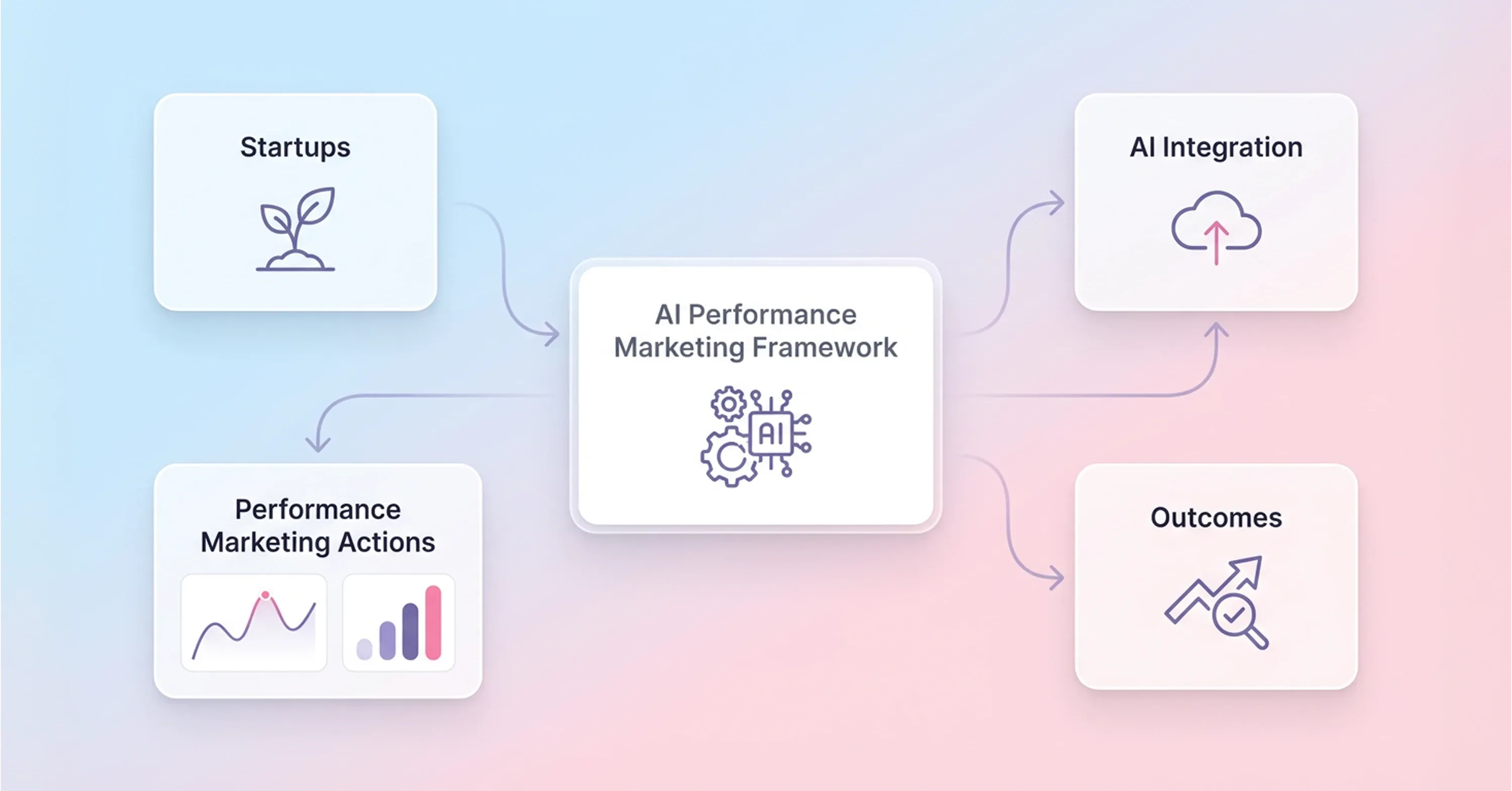
Diagram of an AI performance marketing framework for startups showing AI integration, marketing actions, and business outcomes

Performance Marketing for Startups: Practical Framework for AI Era

In this article, we explain how to build a sustainable growth strategy. This strategy combines disciplined paid acquisition with AI visibility. We discuss the specific steps required to transition from a pure arbitrage model to a hybrid strategy that prioritizes answerability and trust.

Content authorRoman Khlon, MScPublished onReading time11 min read

Introduction

Performance marketing traditionally relies on paid channels to deliver measurable results. Cheap Facebook ads and easy tracking defined this approach for the past decade. Advertisers launched campaigns and observed predictable conversions ten years ago, but the 2026 reality looks different. Privacy regulations block data access. AI agents intercept potential customers before those customers reach a search results page. Consequently, the traditional "ads-only" arbitrage model became expensive and unreliable.

Data indicates that the average B2B SaaS CAC reached $1,200 in 2026. This cost makes the old playbook unsustainable for early-stage companies. Startups face challenges because acquisition costs increase while attribution becomes invisible.

The market requires a new approach. Performance marketing for startups must evolve into a hybrid strategy. This methodology treats AI visibility and paid ads as a single system rather than separate channels. The system captures demand because it builds trust and ensures the brand provides the best answer for human buyers and AI crawlers.

2026 Performance Shift

This system replaces the reliance on cheap clicks that built previous tech giants. Current reality of digital advertising combines high costs with lower visibility. Search engines have evolved into answer engines, and this shift creates a Zero-Click phenomenon where users get their information without ever visiting a website. Data from Ahrefs and Search Engine Land shows that new AI Overviews reduce organic click-through rates by 34.5% for top-ranking positions.

This decline creates a massive problem for the traditional arbitrage model. Marketing teams cannot buy cheap traffic and flip it for a profit when the traffic never arrives at the site. Performance marketing for startups must therefore pivot to a new goal called Answerability. This concept requires a brand to provide the most accurate, concise answer to specific problems so that AI agents cite the brand as the source. Visibility in AI answers has become just as critical as ad placement. The future of digital marketing trends depends on this ability to satisfy both algorithms and humans with precision. Optimizing for answerability ensures that even if the click never happens, the brand impression still occurs within the trusted environment of the AI response.

Phase 1: Build AI-Ready Infrastructure

Answerability requires a digital foundation that teams often overlook when they rush to spend budgets on ads. A successful startup growth marketing strategy begins with Generative Engine Optimization (GEO). This process ensures that AI models can easily read and understand content. Since websites account for 44% of AI citations, owned assets remain the primary source of truth for these intelligent systems. If a site confuses the crawler, the brand disappears from the answer.

The goal is to create "extractable" content. Landing pages must serve two masters: the human user who needs persuasion and the AI crawler that needs facts. Optimizing landing pages for conversion now means structuring data so algorithms can easily pull it into their answers. This requires discipline in presenting information. A page that works for GEO will naturally convert paid traffic better because it answers user questions immediately.

Consider these guidelines for structuring extractable content:

  • Direct Answers: Place the core value proposition or answer to a specific question at the very top of the page.

  • Clear Entities: Use proper nouns and specific terminology that clearly identify the product category and features.

  • Structured Data: Implement schema markup to help crawlers understand the relationship between different pieces of information.

  • Fact-Based Claims: Support marketing claims with specific numbers or data points that AI can verify and cite.

Phase 2: Select One Power Channel

Teams often dilute the impact of this verified content by spreading a small budget across too many platforms. Data indicates that 22% of failed startups lacked sound marketing strategies during their launch phase, and this often stems from a lack of focus. A scattered approach prevents the team from gathering enough data to optimize any single source of traffic effectively, which violates core lean marketing principles. Startups simply do not have the resources to fight a war on three fronts simultaneously.

Instead of trying to be everywhere, teams should select exactly one "Power Channel." The decision should rely on a "High Profit/Low Effort" matrix rather than current trends. If a product solves an urgent problem, Google Ads often works best because it captures high intent. If the product creates a new category, LinkedIn or Meta might offer better reach for the effort required. Choosing the right marketing channel requires a deep commitment to mastering that specific platform’s nuances before moving to the next one. This singular focus allows the team to iterate quickly and build a reliable engine for performance marketing for startups. Once this single channel delivers predictable returns, the team can then expand to others.

Phase 3: Hybrid Engine Loop

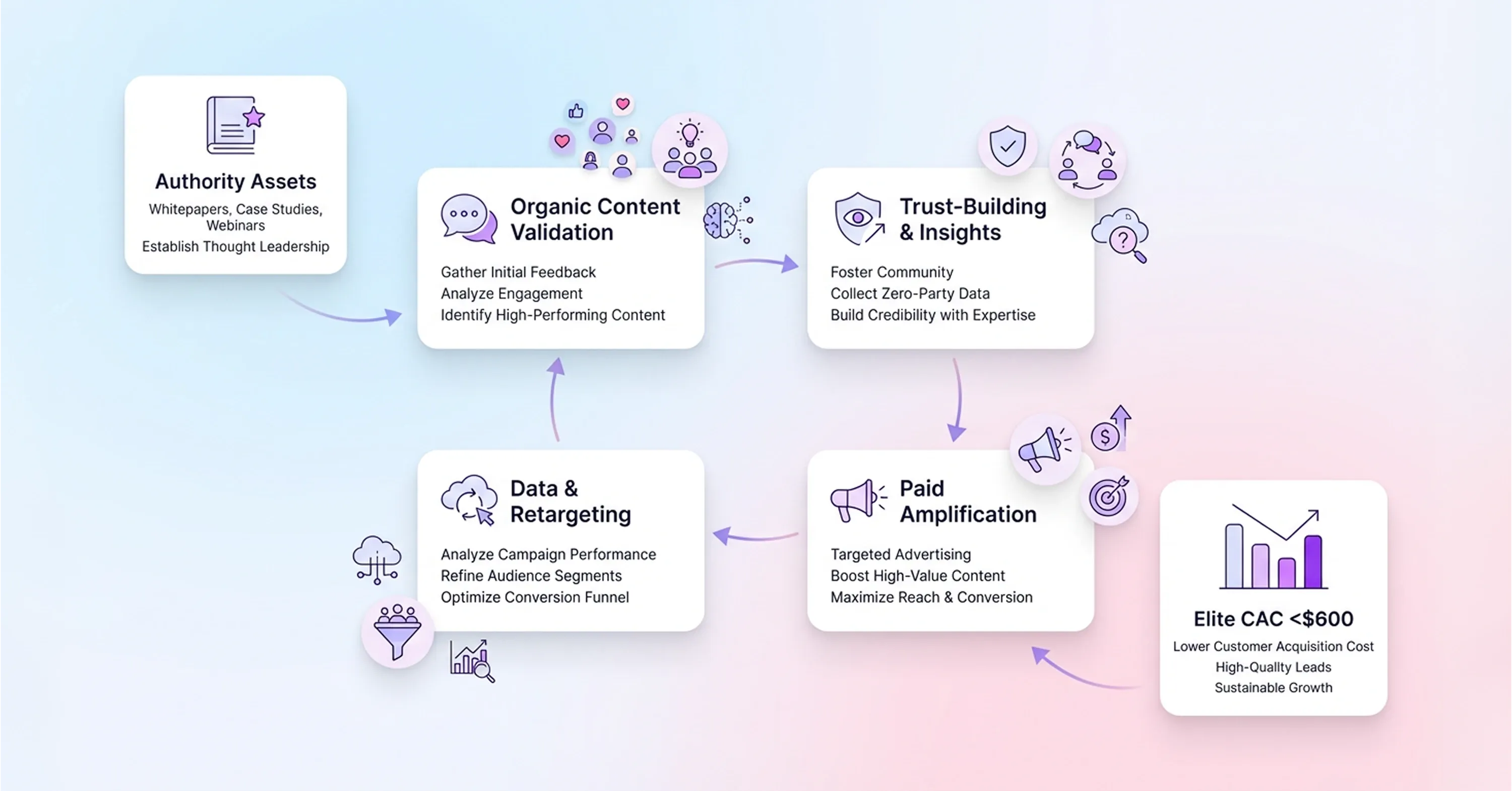
AI performance marketing growth loop showing authority content, organic validation, trust building, paid amplification, and retargeting to reduce CAC

The operational core of the hybrid model functions as a continuous feedback loop that powers the single channel. This approach generates momentum because it treats every piece of content as both a trust-builder for humans and a data point for algorithms. The hybrid engine avoids the launch of cold ads and relies on a strict validation process. Startups prove that a message resonates with real people before they pay to distribute it.

This process requires the tight integration of content creation and ad buying. The marketing team publishes organic insights to gauge engagement and promotes the high-performing pieces to a broader audience. Finally, deep-dive assets like white papers or detailed guides capture those who need more information. This method ensures that paid spend only amplifies messages that have already proven their value. Moreover, these authority assets serve a dual purpose. They convert human leads and feed AI models with the high-quality information needed to rank in search results. Building trust with content creates a sustainable foundation for performance marketing for startups that survives beyond the duration of a single ad campaign.

Message Validation via Organic Content

Teams build this sustainable foundation when they use organic social proof as a filter for ad creative. Startups test hooks, angles, and value propositions through founder-led content on platforms like LinkedIn or X before they commit significant budget to a campaign. If a post fails to generate interest organically, paid promotion rarely fixes the underlying issue.

This approach keeps the strategy lean marketing compliant because it minimizes waste. Authentic engagement signals indicate which problems the audience actually cares about. Wil Reynolds from Seer Interactive notes that in the current search landscape, organic success depends on earning trust rather than gaming algorithms. When founders share insights that solve problems, they build a reservoir of trust. The marketing team harvests the data from these organic interactions to inform the paid strategy. This ensures that every dollar spent amplifies a message that already works.

Authority Asset Amplification, Retargeting

The team puts paid spend behind this working message to achieve scale. Strategies include boosting the best-performing posts or creating ad variations based on the successful themes. The goal maximizes the reach of proven ideas instead of guessing what might work.

Retargeting closes the loop when it serves authority assets to users who engaged with the initial content. Case studies, white papers, and detailed technical guides work best here. These assets demonstrate expertise and convince hesitant buyers. They also function as training data for AI search engines because these engines scan for deep, authoritative sources to answer user queries. High-quality reference material ensures the brand appears in AI-generated answers. Data from SaaS Hero indicates that elite B2B SaaS performers maintain customer acquisition costs under $600, a benchmark achievable only when paid spend targets audiences already primed by high-quality, authoritative content.

Phase 4: Directional Attribution Implementation

Measuring the success of this targeted paid spend requires a pragmatic approach that avoids expensive enterprise tracking tools. In a privacy-first world where cookies crumble and browsers block trackers, the quest for perfect attribution acts as a distraction. Instead, growth leads implement "Minimal Viable Attribution." This approach accepts that perfect tracking is impossible and focuses on clarity to make informed decisions.

This method combines directional signals with platform metrics to triangulate the truth. For example, a simple "How did you hear about us?" survey field on a signup form often reveals sources that software misses, such as podcasts, dark social, or word of mouth. A clearer picture emerges when the marketing team compares these self-reported answers with data from Google Analytics and ad platforms. Elena Verna argues that last-click attribution models give a false sense of precision to marketers. This leads them to overinvest in bottom-of-funnel tactics while they neglect the channels that actually create demand.

Performance marketing for startups requires an honest assessment of what works. Triangulating data sources allows founders to see which channels drive high-quality signups rather than just cheap clicks. Our startup attribution guide explains the setup for this process. This information allows the team to allocate the budget based on actual business impact.

Phase 5: 30-Day Optimization Sprint

The team allocates this budget effectively when they follow a structured timeline to test, measure, and iterate on the hybrid strategy. A thirty-day sprint provides enough time to gather statistical significance without committing to a failing strategy for too long. The goal moves the budget from inefficient tactics to efficient ones with high velocity. This disciplined approach ensures the company maintains a healthy financial trajectory. According to Prospeo, a healthy LTV:CAC ratio should be at least 3:1 for long-term viability.

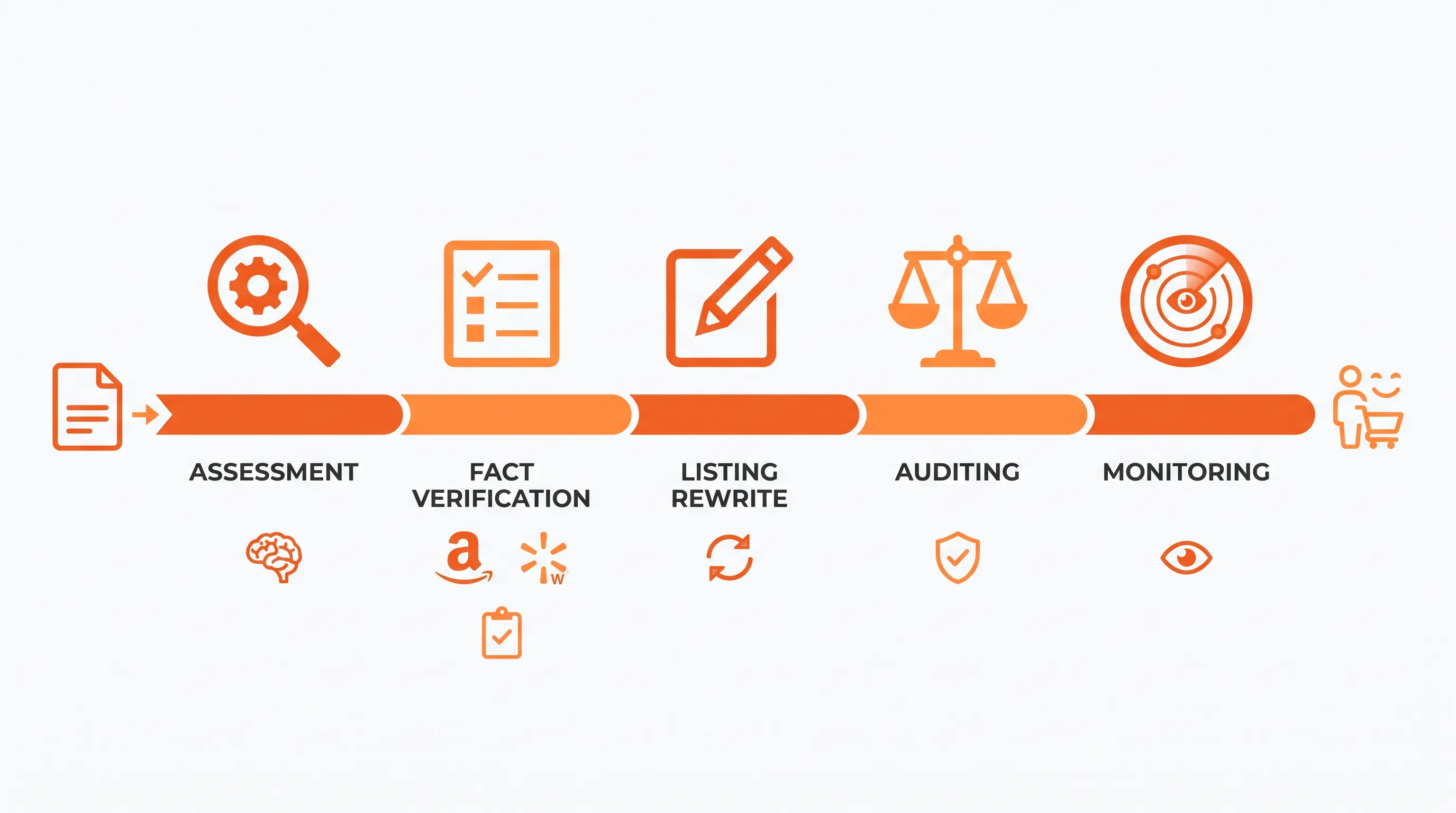
To maintain efficiency in startup growth marketing, the team follows a strict schedule:

  1. Launch: The team sets up accounts and creative assets for the selected power channel.

  2. Observe: Campaigns run without interference to establish a baseline.

  3. Analyze: The team reviews initial data against the directional attribution signals.

  4. Refine: The team cuts underperforming ad sets and doubles down on the winners.

This disciplined cycle prevents emotional decisions and keeps the strategy on track.

Weeks 1-2: Launch, Data Collection

The strategy stays on track because the first two weeks focus entirely on launching the chosen power channel and gathering baseline data. During this period, the team resists the urge to tinker with the campaigns daily. Algorithms need time to learn, and premature optimization often kills performance before it stabilizes. Patience is the most critical asset during this phase.

The growth lead ensures that all feedback loops are functional. Tasks include verifying that the "How did you hear about us?" survey collects data and that the ad platform pixels fire correctly. The startup growth marketing strategy relies on accurate data collection from day one. The campaigns yield a statistically significant dataset by the end of the second week.

Weeks 3-4: Analysis, Reallocation

The team uses this statistically significant dataset to take decisive action in weeks three and four. The team analyzes the performance of each creative asset and audience segment. If an ad set has a high cost per acquisition (CPA) and low conversion rate, the team cuts it immediately. Resources then shift to the best-performing ads to maximize the return on ad spend.

This reallocation ensures that the budget flows constantly toward the most efficient tactics. The analysis also cross-references platform metrics with the survey data collected in the first two weeks. If a channel shows poor direct attribution but appears frequently in customer surveys, it likely drives awareness that converts later. These nuances allow the team to refine the hybrid engine for maximum output.

Conclusion

Refining the hybrid engine demonstrates that performance marketing moved beyond buying attention because it engineers trust. Brands will succeed in 2026 if they serve as the best answer for both human buyers and AI crawlers. A hybrid engine of trust-based content and disciplined execution replaces old arbitrage models and creates a sustainable path to growth that survives algorithm changes.

This transition begins today. Auditing budget allocation and checking the top landing page for extractability help align resources. Making the business answerable now builds a defensible advantage for the future of performance marketing for startups.

Privacy regulations block data access, and AI agents intercept customers before they click ads. This reality drives up costs because the traditional arbitrage model fails. You must shift to a strategy that prioritizes answerability and trust to succeed in performance marketing for startups today.

You need to structure your data so algorithms can easily read it. Snoika helps businesses identify their brand presence in AI responses and create optimized content. This ensures your brand appears as a trusted source when users ask questions on platforms like ChatGPT.

You shouldn't spread your budget across many platforms during the launch phase. Focus on one power channel like Google Ads or LinkedIn to gather reliable data. This approach allows you to master the platform's nuances and build a predictable growth engine before you expand.

You can use a simple survey field on your signup form to ask users how they found you. This method captures sources that software misses, such as podcasts or word of mouth. You should compare these self-reported answers with your analytics data to find the truth.

You should run your campaigns for at least two weeks before you make major changes. Algorithms need this time to learn and stabilize performance. After this period, you can cut the ads that have high costs and move your budget to the winners.

Schedule a Meeting

Book a time that works best for you

You Might Also Like

Discover more insights and articles

Unified marketing platform integrating email, analytics, social media, and ad campaigns to improve efficiency and reduce costs.

Complete Guide To Performance Marketing Tools: Stack Fragmentation Prevention

In this article, we examine how the rapid adoption of specialized software creates integration debt and fragments data across organizations. We provide a strategic framework for selecting and uniting these systems around a centralized core platform to protect data governance and improve campaign returns.

Diagram of a hybrid marketing framework combining internal first-party data with external testing and execution to improve retention and performance

In-House vs Agency Marketing: B2B Framework For Hybrid Performance Teams

In this article, we examine how artificial intelligence and automated media buying change traditional marketing departments. We explain how organizations construct hybrid frameworks that combine internal strategic control with external execution speed to increase revenue.

Marketing analytics dashboard showing paid media scaling, ROAS break-even analysis, POAS profitability, margin ceiling, and budget allocation across ad channels

How To Scale Paid Media: Advanced Profitability Guide 2026

In this article, we explain how companies systematically increase advertising budgets while they defend bottom-line profit. We break down the exact margin calculations and tracking infrastructure that organizations require to grow campaigns without financial losses.

Infographic showing factors that sabotage marketing campaign ROI including broken attribution, data corruption, targeting mismatch, and budget burn

Performance Marketing Mistakes: 7 Strategic Errors Sabotage Campaign ROI

In this article, we examine hidden technical and strategic errors that drain advertising budgets. We discuss how a focus on data integrity and creative strategy corrects common performance marketing mistakes.