How to Build a Leadership Case for GEO, AEO, and LLM Visibility

Content authorArtem Lozinsky, EMBA, MScPublished onReading time12 min read
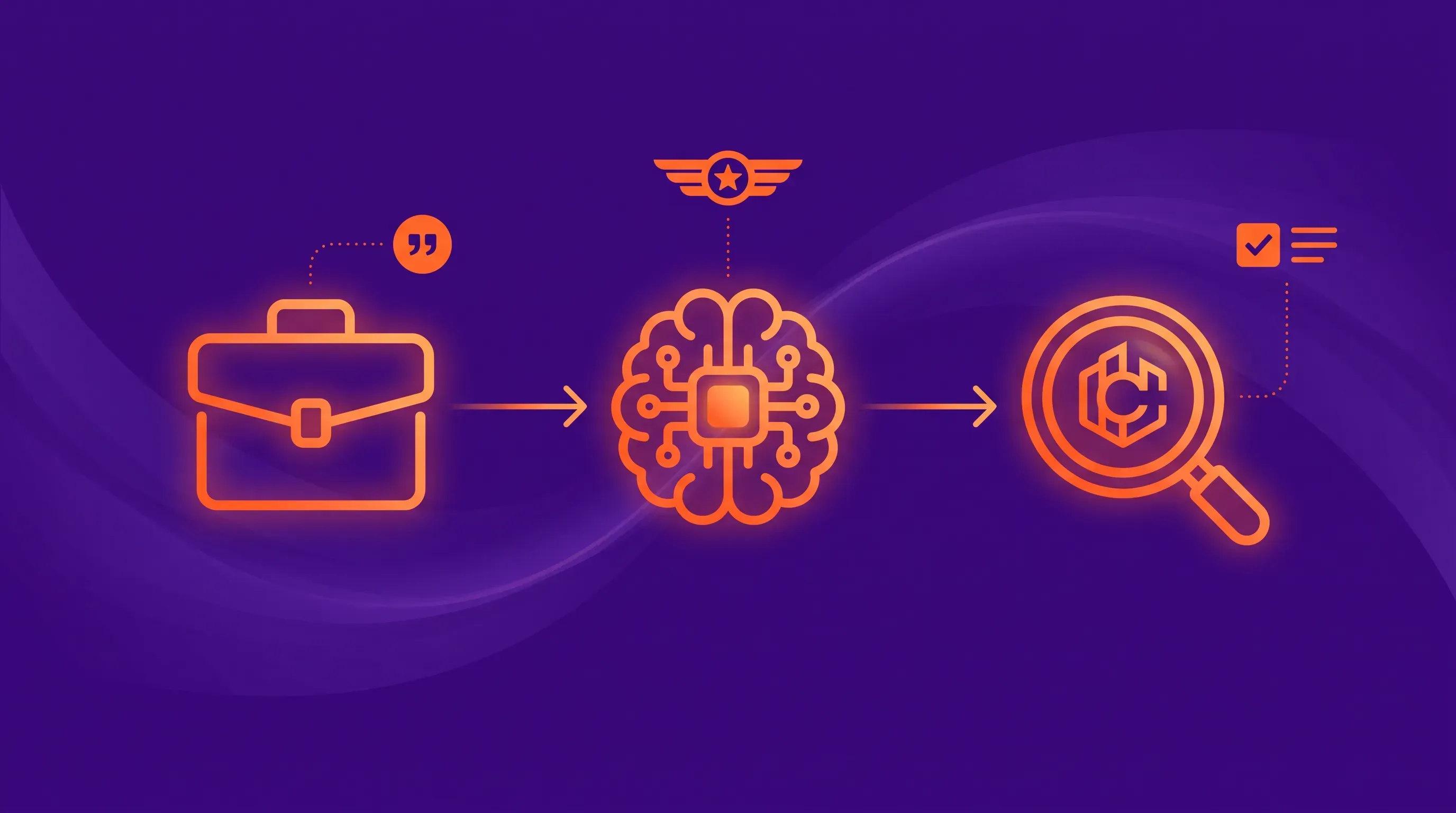
Ultra-minimal flow illustration on deep violet background featuring glowing icons for leadership, AI, and analysis, connected by an orange arrow.

Build the case around business exposure. Show where AI-generated answers already influence how buyers shortlist vendors in your category and request approval for one bounded pilot with predetermined scale-or-stop criteria.

Leaders need outcomes, not acronyms

Generative Engine Optimization (GEO) and Answer Engine Optimization (AEO) name the same underlying job: influencing whether AI-generated answers mention your company when someone is deciding what to buy. Drop the labels in the room and describe the outcome instead.

The outcome is presence inside an answer your company doesn't control. Forrester's 2026 Buyers' Journey Survey of 18,000 global business buyers found that 94% used AI during their most recent purchase, with 55% using it specifically to compare vendors. That's the moment your name either appears or doesn't.

Which means the real question for a leadership team is whether the company can describe, with evidence, what a machine says about it during a comparison. Most can't answer that today, and the inability to answer is the exposure. Everything else in this case flows from closing that gap.

AI visibility extends traditional SEO

Strong technical Search Engine Optimization (SEO) and genuinely useful content stay foundational. AI visibility adds a layer on top: citation tracking and discovery that happens without any click on your site.

The layer matters because ranking no longer predicts citation the way it once did. An Ahrefs analysis found that just over 37% of cited pages ranked in the organic top 10, while nearly 37% didn't rank in the top 100 at all for the query. Earlier work by the same team had put that top-10 figure at 76%.

So a page can rank well and stay absent from the answer. Two datasets that disagree on the exact number still agree on the direction, and the direction is what your leadership team needs to hear: position tracking alone has stopped describing your visibility. Semrush found that organizations combining SEO and AI visibility in one workflow reported gains at 81%, against 36% for teams running them separately.

Why should leadership care now?

Because the shortlist is being assembled somewhere your analytics can't see. Prospects read the generated comparison and form a trust judgment before they ever reach a page you own.

The revenue math follows the behavior. Adobe Analytics measured more than a trillion visits to US retail sites and found AI-referred traffic converting 54% better than non-AI traffic in May 2026, which reversed a pattern from a year earlier when the same traffic converted at roughly half the rate. Contentsquare, meanwhile, put AI-referred visits at 0.2% of all sessions.

Both numbers are sound, and holding them together is the honest version of the argument. The channel is small and the visitors it sends are the most decided people arriving at your site. A leadership team that hears only the conversion figure will overfund this. One that hears only the traffic share will ignore it for a year. Give them both, because credibility on the downside is what buys you the pilot.

When does investment make sense?

Investment makes sense when you can point to three verified conditions. Approval criteria beat urgency, because urgency invites the follow-up question you can't answer.

Semrush's 2026 research found that 45% of marketing leaders can't accurately measure their brand's visibility inside AI-generated answers, and only 9% have tooling covering all relevant metrics across platforms. That gap explains why so many requests get declined. They arrive as conviction without a baseline.

Which gives you an advantage if you walk in with the opposite. A request grounded in observed behavior and observed competitor presence reads as diligence. The three sections below are the conditions worth verifying before you book the meeting. If two hold and one doesn't, say so out loud, since the credibility you earn by naming the weak condition is worth more than the budget you'd win by hiding it.

Customers use AI during decisions

Verify that your priority buyers actually ask AI tools the kinds of questions that shape consideration: category questions and comparisons. Ask customers directly in win-loss calls and discovery notes.

G2's March 2026 survey of 1,076 B2B decision makers found 51% now begin software research with an AI chatbot more often than with Google, up from 29% in April 2025. A broader 71% rely on chatbots somewhere in the process.

A doubling inside eleven months tells you something the headline number doesn't. Whatever share of your own buyers behaves this way today, the figure you gather now is a floor. So capture the baseline before it moves again, and date-stamp it in the briefing so your leadership team can see the trajectory rather than a snapshot.

Need help with your AI visibility?

Book a free consultation with our experts we'll help you determine exactly which services your organization needs.

Competitors already shape AI answers

Run your own prompt tests before the meeting. A repeatable set of category and comparison prompts across the engines your buyers use will show you which competitors earn mentions and where your brand is missing.

The relative read is the one that matters. As SolCrys notes in its work on visibility monitoring, a brand can look healthy in isolation and still sit near the bottom of its tracked competitor set, with owned pages under 2% of the citations feeding answers in its own category.

Misrepresentation deserves its own line in your briefing, separate from absence. Absence costs you consideration. A wrong pricing model or a miscategorized product in a generated answer actively works against you, because the buyer reads it as neutral guidance. That distinction changes the priority order of the work you'll propose, and executives grasp it immediately.

Existing assets can support a pilot

If your company already has content that performs and sound technical SEO, you can test GEO without funding a separate program first. The pilot uses what exists and measures what changes.

Budget mobility supports this. Gartner's 2026 CMO Spend Survey of 401 marketing leaders found CMOs allocate an average of 15.3% of marketing budget to AI. The share reaches 21.3% among AI-ready organizations. The money for a bounded test is approved already, just pointed elsewhere.

Framing the ask as redirection changes the conversation from spending to sequencing. And it gives you a defensible answer to the cost question, since a pilot built on existing content and existing SEO work carries a marginal cost your finance partner can actually verify. That's the version of the request that survives a budget review.

What should marketers avoid promising?

Never promise inclusion or a revenue figure. Generated responses vary by engine and the day you run them, so any guarantee you offer will be falsified in front of the people who approved it.

The variance is measurable. Within-LLM variance from sampling alone hits 10 to 34% on identical prompts, according to Kevin Indig, growth advisor and author of the Growth Memo newsletter. Five people running the same query get five different answers.

Say that number out loud in the briefing. Naming variance before anyone asks converts your weakest point into evidence that you understand the mechanism, and it sets the standard you'll actually be judged against: directional movement across repeated runs. Here's what you can commit to instead:

  • A measured baseline of how your brand and named competitors appear across a fixed prompt set

  • Documented improvement work on the assets and signals feeding those answers

  • Regular reporting on movement, with the measurement limits stated each time

How should progress be measured?

Measure with a fixed, repeatable prompt set run on a schedule across the engines your buyers use, then track movement over time. Repetition is the method, because it's the only way to separate signal from sampling noise.

Track mention frequency and share of voice against a named competitor set. Add the sources those answers cite, plus AI referral sessions in your analytics. Semrush's study found that 32% of marketers call AI search visibility clearly measurable in business terms, with fragmented data across tools cited by 33%.

Treat every referral figure you report as a floor. In-app browsers and noreferrer links strip the referrer, so a portion of AI-driven arrivals lands in your reporting as direct traffic. State that in the footnote of your dashboard, since a leadership team that later discovers the undercount on its own will discount everything else you showed them.

Need help with your AI visibility?

Book a free consultation with our experts we'll help you determine exactly which services your organization needs.

What should leaders approve first?

Approve a time-bound pilot, nothing larger. It's the prudent first commitment because it produces the evidence a bigger decision requires without asking anyone to bet on a channel the company hasn't yet measured.

Define the scope tightly. A pilot needs a fixed prompt set and criteria written down in advance for stopping. Write the stop criteria first, because criteria set after the data arrives are rationalizations.

Precedent helps here. Gartner's 2026 CFO survey ranks cost optimization at 56% and forecast accuracy at 51% among top priorities, and a 90-day pilot with a modest budget is the standard mechanism for proving value before a multi-year commitment. That's a shape your finance partner has approved many times in other contexts, which is exactly why it clears review faster than a program request.

What belongs in the leadership briefing?

Open with the business change and close with the single decision you need. The structure works because it moves from what's happening to what you want approved without detouring into how the technology functions.

Keep it short enough to present in ten minutes. Fractl data reported by Digiday on 7 August 2026 found marketers now route roughly 24% of search and content budgets to AI visibility work, with 82% allocating at least something. Your ask isn't unusual, so don't present it as though it were novel.

Every section that follows advances the same argument you opened with: your buyers are forming shortlists inside generated answers and you want a bounded test. If a slide doesn't move that argument forward, cut it. Length reads as uncertainty in a room where the decision takes two minutes.

State the business change

Describe what's shifted in your specific customer discovery journey. Skip claims about AI replacing search, because that framing is easy to argue with and it isn't the point you need.

Ground it in your own funnel. Forrester reported in February 2026 that B2B companies are seeing traffic declines of 10 to 40% as research migrates into AI answer engines, and its analysts describe speaking with dozens of marketing leaders reporting demand volume drops of 20 to 30%.

Then put your own numbers beside theirs. If your organic traffic held steady while demo requests softened, say that. If a rep noted a prospect arriving with a competitor comparison they didn't get from you, put it in the briefing. A named internal observation lands harder than any industry figure, because your leadership team can verify it and can't dismiss it as somebody else's market.

Present evidence, not hype

Show the baseline prompt results themselves. Which competitors appeared and how your brand was described.

Include the accuracy problem explicitly if you found one. Search Engine Land reported a comparison of 29 large language models with hallucination rates from 15% to 52%, which is the mechanism behind any wrong claim about your product that shows up in an answer.

Present a limitation on the same page as a finding. A briefing that lists what the data can't tell you reads as measurement, while one that lists only wins reads as advocacy. Your leadership team is deciding whether to trust your reporting for the next two quarters, and this slide is where that gets decided.

Propose a bounded response

Name the scope and the one person accountable. Make every element specific enough that someone could audit it later.

Point the work at what the engines actually use. The 2026 Muck Rack and Generative Pulse analysis found that more than 85% of AI citations come from earned media sources, which reframes part of the pilot as a communications and third-party presence problem.

That finding changes your resource request. If earned sources dominate citations, a pilot funded entirely as a content-production line item is aimed at the wrong surface. Split the plan between your own assets and the independent sources describing you, and say why in the briefing. Leaders approve plans faster when the allocation logic is visible.

Request one clear decision

End with the exact approval you need and the evidence that will determine what happens next. One decision, stated in one sentence, with a number and a date attached.

Then name the review trigger. Say which metrics you'll report at 90 days and what ends it. The 10Fold survey cited by Digiday on 7 August 2026 found 52% of B2B marketers rate AI answer engines their most effective distribution channel while 41% have optimized under half their content for AI discovery, so the gap between rating and readiness is where most programs stall.

Offering the stop condition yourself is the move that wins the approval. It signals you're asking for a test, and it removes the reviewer's main objection before it's raised. A leadership team rarely refuses a bounded experiment that comes with its own exit.

Build the baseline with Snoika

Get the baseline before you present, because the briefing described above is only as strong as the prompt data behind it. Snoika tracks how your brand appears in AI answers across ChatGPT and Google AI Overviews. It reports mentions and the sources those answers draw on.

The platform runs the prompt sets on a schedule with historical comparison in the reporting, which addresses the variance problem directly. It also shows which competitors appear when your brand doesn't, so the competitive slide in your briefing comes from measurement.

Snoika's free AI Visibility Monitoring feature is available at snoika.com, and the AI Visibility Report adds a readiness view of how well your site supports AI discovery. Run your priority prompts through it and bring the numbers to your leadership meeting.

Need help with your AI visibility?

Book a free consultation with our experts we'll help you determine exactly which services your organization needs.

Choose prompts from customer calls, sales emails, and win-loss notes. Use the exact category and comparison questions buyers ask before they contact your team. Exclude branded support questions, since they measure customer assistance rather than vendor consideration. Record the wording, engine, date, and market for every prompt.

A marketing leader should own the pilot because the work spans content, search, and brand positioning. Assign one accountable person who can request product facts from subject specialists and collect sales feedback. Finance or operations should review the baseline, budget, and exit criteria before the work begins.

Yes, a small pilot can begin with a spreadsheet and a fixed testing routine. Run each prompt repeatedly in the same AI tools, save the full responses, and log brand mentions, cited sources, and accuracy issues. Manual checks become difficult when prompt volume or reporting frequency increases.

Document the exact claim, prompt, engine, and date first. Then correct the underlying public information on your site if it is unclear or outdated, and check independent pages that repeat the error. Don't attempt to treat one corrected response as proof that the problem has disappeared. Re-test the prompt on schedule.

Stop the pilot when its prewritten review criteria aren't met at the agreed date. Criteria should cover movement in targeted mentions or citation quality, plus the effort and cost required to sustain the work. Continue only if the results support a defined next scope and an accountable owner.

Schedule a Meeting

Book a time that works best for you

You Might Also Like

Discover more insights and articles

Minimalistic SaaS marketing illustration featuring a central ChatGPT icon with a violet background, brand icons interacting with a filter, and an auditor icon.

Why ChatGPT Mentions Competitors Instead of Your Brand: A Visibility Gap Audit

ChatGPT names competitors instead of your brand when it can't confidently identify your company and connect it to the prompt's category with sources it trusts. Some of that absence is random sampling. The rest is a real evidence gap, and you can separate the two by testing the same prompts repeatedly and recording what comes back.

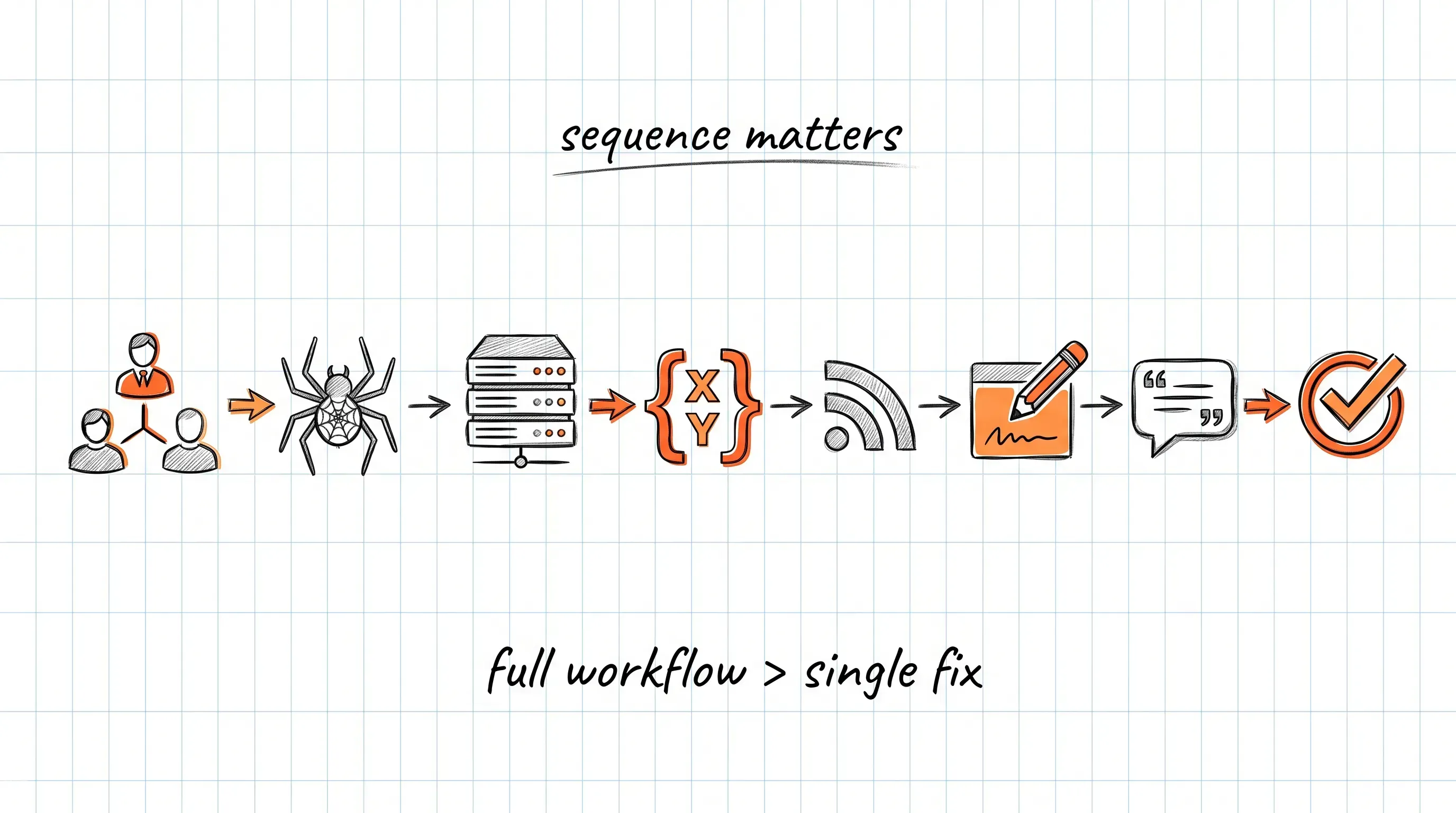
Hand-drawn wireframe flowchart on notebook paper showing AEO implementation workflow for ecommerce product pages with annotated icons.

How ecommerce teams implement AEO for product pages

This article gives you an ordered AEO workflow for making product pages readable and quotable inside AI answers. It covers crawler access and server-rendered facts. Schema and feed alignment then lead into content rewrites and citation tracking. The sequence matters more than any single fix.

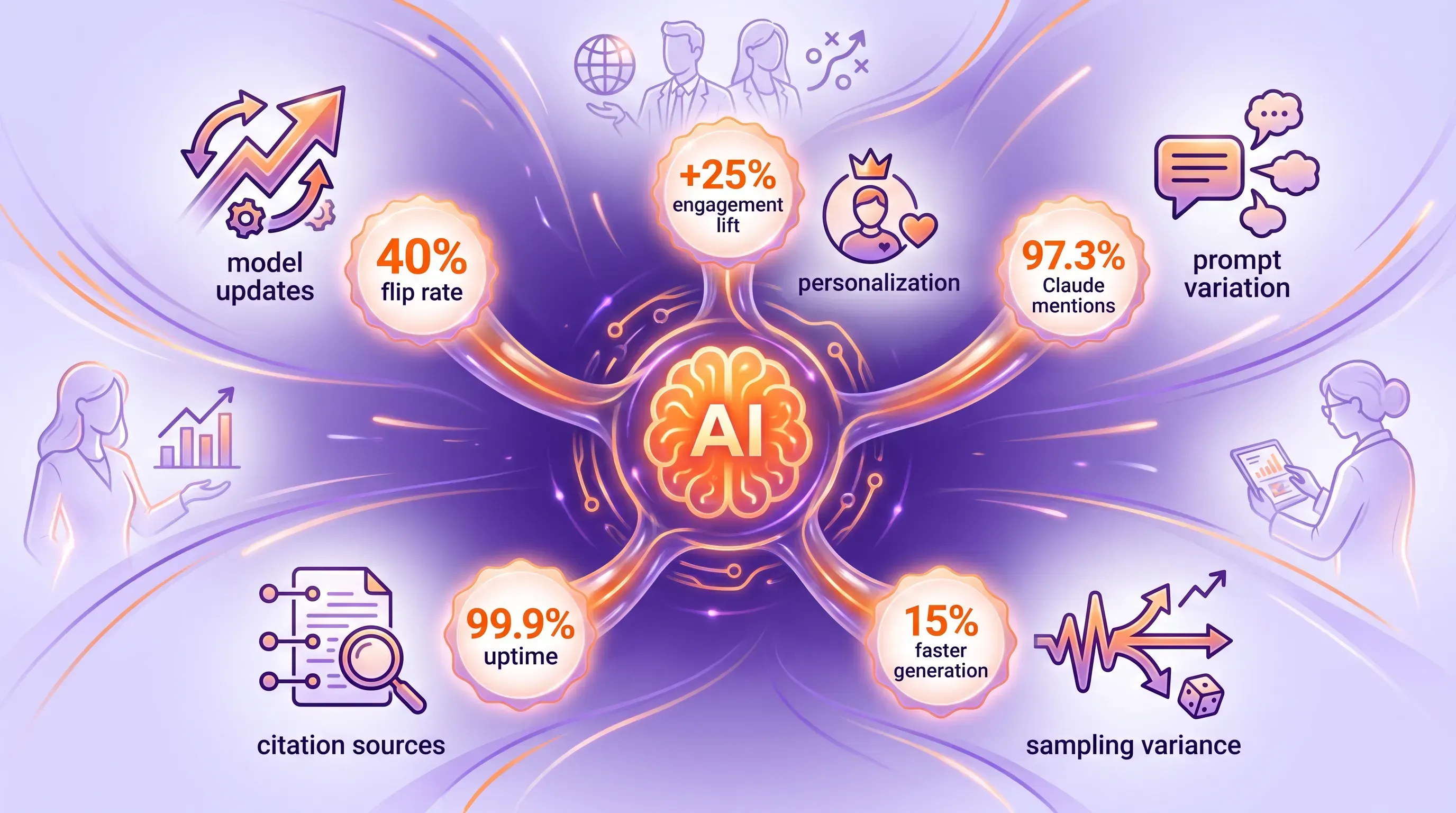
A vibrant illustration featuring a glowing AI-brain icon at the center, surrounded by dynamic line icons and luminous badges in deep violet hues.

AI Brand Mention Tracking Limits: What to Know Before You Invest

AI brand mention tracking reliably shows you directional trends and relative presence over time. AI answers can differ between identical runs. They also personalize by user and change after model updates, so treat these numbers as confidence ranges and never report a single snapshot as fact.

Title:
15 best AI tools for SEO ranked for content keywords and competitors

Meta description:
Compare the best AI tools for SEO so you can find keyword gaps and analyze competitors without extra tool

15 best AI tools for SEO ranked for content keywords and competitors

This article ranks 15 best AI tools for SEO based on two jobs: finding worthwhile content keywords and exposing competitor openings. Each entry names one differentiator and the team it suits. Its limitation fixes its place, so you can pick one primary platform and add a specialist only when the data demands it.