How the ROI question has shifted
Marketers are no longer asking whether to hire marketing agencies or buy software. They're asking which mix produces the strongest return on a shrinking budget. According to Gartner's 2024 CMO Spend Survey, marketing budgets dropped to 7.7% of overall company revenue in 2024, down from 9.1% the year before, and digital ad agencies are feeling the squeeze alongside their clients.
At the same time, automation has eaten most of the manual work that used to justify agency retainers. Programmatic buying now accounts for more than 91% of US digital display ad spend, which means the act of placing media is a solved problem. The real value sits in strategy and creative quality, especially when the feedback loop is fast.
This piece treats the agency-versus-AI debate as a question of measurable returns. We'll look at what each model delivers and where each one breaks, with a decision process for matching the model to a given team. The goal is a clearer picture of where your next dollar should go.
What digital ad agencies actually deliver
When a company hires a digital ad agency today, it's buying access to four things at once: strategists, creatives, media buyers, and account managers. The service mix covers paid search, paid social, programmatic display, analytics, and some level of creative production. Pricing is split across retainers and usage-based fees tied to time or ad spend.
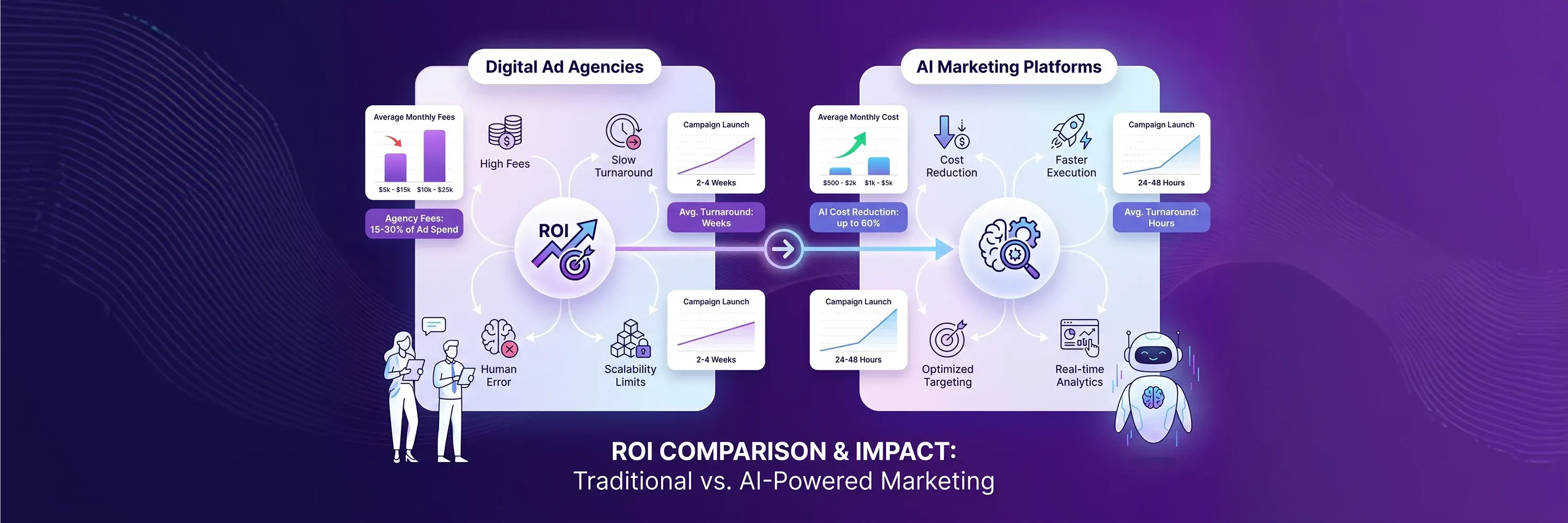
The percentage-of-spend model is the most common. Industry data on digital ad agencies from HawkSEM and similar pricing reports puts the standard range at 10-20% of ad spend, with performance shops charging 15-20% depending on volume and service depth. Hourly rates for mid-sized agencies sit between $125 and $200 per hour, and large 50+ person shops charge $150-$300+. That's the cost side. The value side is harder to price.
Digital ad agencies sell expertise. The argument is that a senior strategist with a decade of category experience will avoid expensive mistakes a junior in-house marketer would make. That argument holds, but only when the agency assigns the senior person to the actual work, which isn't always the case.
Strategic judgment from marketing agencies
The strongest case for marketing agencies sits in strategic judgment. Human pattern recognition across dozens of prior campaigns helps teams position a SaaS product against three incumbents and decide whether paid social or webinars should lead while audience priorities shift between defense and expansion. Senior strategists translate vague business goals into campaign structures with budgets and KPIs attached to the right channels.
This judgment is hard to replicate with automation because it depends on context the model has never seen. A competitor's funding round and a pricing change two quarters ago rarely live in any dataset an AI can query, and a CEO's channel preference is just as likely to sit outside it. Good digital ad agencies absorb that context through conversation and turn it into a plan.
That's why marketing agencies still win when the strategic question is open-ended. The work involves deciding what the channel mix should be in the first place.
Creative direction and brand work
Creative is the other domain where digital ad agencies hold ground. Human taste still matters when a brand campaign needs both a long-lived tagline and launch-video art direction. Even when media buying is fully automated, the creative inside the ad determines most of the performance variance.
Meta's own studies have repeatedly shown that creative quality drives the majority of return on ad spend, and Nielsen's CPG research attributes 47% of sales lift to creative versus media placement. An agency that produces a stronger hook or a more memorable brand story can outperform a faster, cheaper competitor on raw return.
Good creative also compounds. A brand identity built by a strong art director pays off for years across every channel. Cheap, generic creative needs constant replacement, which eats the savings that drew the team toward automation in the first place.
Complex account management by paid media agencies
At enterprise spend levels, paid media agencies earn their fee through coordination. A campaign that runs across Google, Meta, LinkedIn, TikTok, and a programmatic DSP needs someone watching attribution, pacing, frequency caps, and compliance across all of them. A dedicated account manager keeps the channels from cannibalizing each other.
This becomes critical when ad budgets cross seven figures per month or when the client operates in regulated categories such as pharma and finance. Paid media agencies hold direct relationships with platform reps and the audit trails that compliance teams need, with beta access to new ad formats available through those relationships.
A solo operator using AI tools can't replicate that web of relationships. Neither can a small in-house team. This is the layer where paid media agencies still command premium fees with a straight face.
What AI platforms bring to the table

AI marketing platforms cover a different set of tasks: automated bidding, audience modeling, copy generation, creative variants, performance dashboards, and predictive pacing. The shift removes the production drag that sits between an idea and a live campaign.
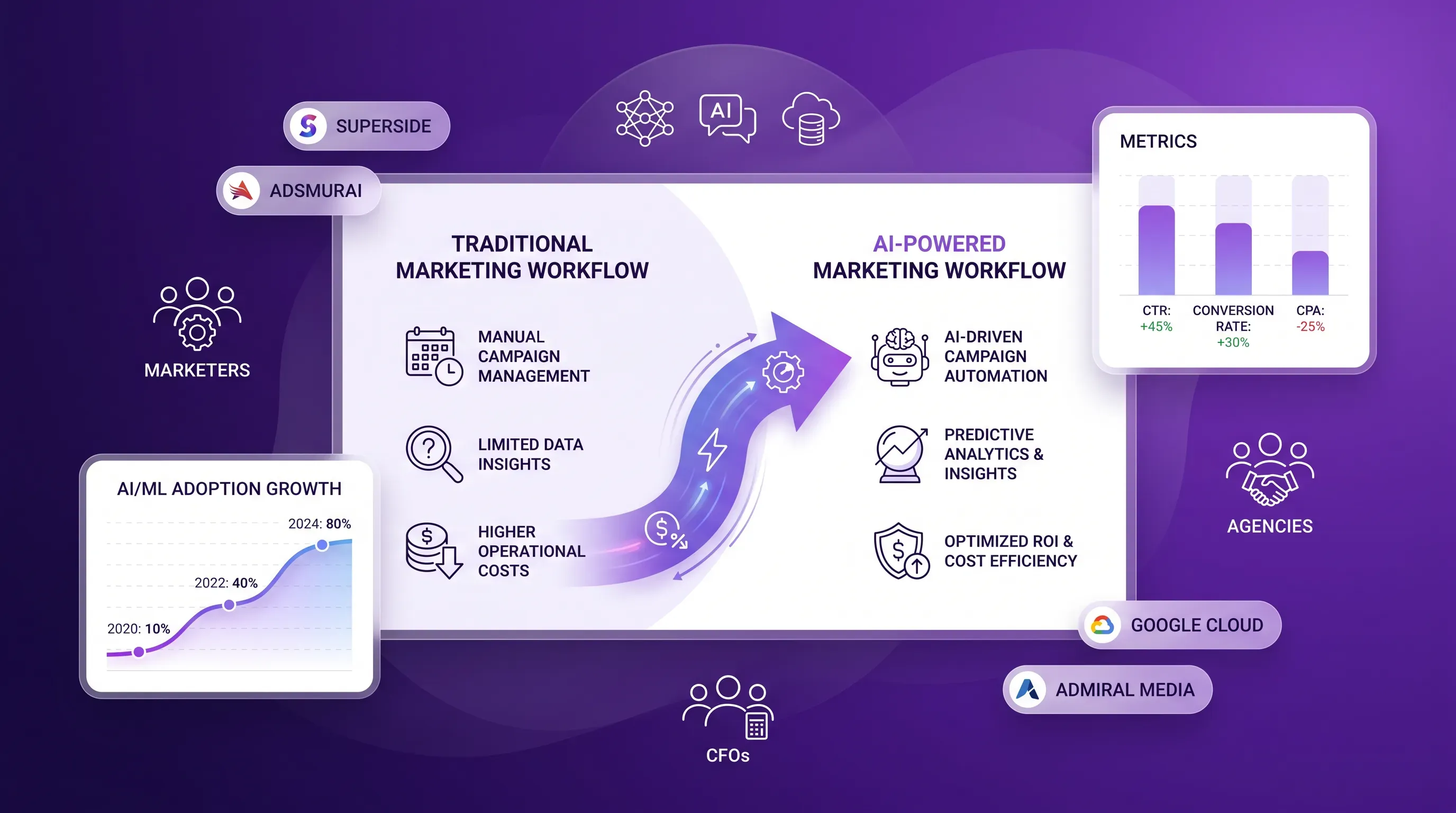
Marketers now use AI and machine learning 13.1% of the time according to the Fall 2024 CMO Survey, up from 8.6% in Fall 2022, and they expect that share to hit 34.5% within three years. The day-to-day change for the marketer is concrete: fewer briefs sent to designers and fewer weeks waiting for a banner refresh.
Lower cost per output
The clearest win is unit cost. Digital ad agencies that produce 10 ad variants bill 20-30 hours of design and copy time. A platform with generative creative can produce the same 10 variants in an afternoon at the cost of a subscription. Superside reported producing creative assets at 85% lower cost per image in its own AI-first rebrand, and 75% less time spent per image.
The saving is real when the work is high-volume and pattern-based: ad headlines, product description variants, paid social statics, weekly reports. The saving is misleading when the output needs strategic framing or original creative thinking. Cutting 20 hours from a banner production cycle matters. Cutting 20 hours from concepting a launch campaign produces a worse launch.
This is the line buyers keep missing. Cost per output drops sharply, and the drop is smaller for good output; breakthrough creative barely moves at all.
Faster campaign launches
Speed is the second shift, and it compounds. A typical agency cycle from brief to live campaign runs three to six weeks. AI workflows compress that to days. Admiral Media's StoryBeat case study documented a 50%+ reduction in production time, with the time from creative brief to live ad cut in half.
The Kalshi NBA Finals spot is a sharper example. The brand's team produced a finished video ad in under 72 hours for $2,000, then aired it during the broadcast. A traditional agency timeline would have missed the cultural moment entirely.
Faster launches matter because they compound into more learning cycles per quarter. A team that ships 12 campaigns a year gathers four times the performance data of a team that ships three. That data feeds the next campaign, which is where the real ROI gap opens.
Tighter feedback loops and visibility
The third shift is visibility. AI platforms pull performance data in near real time and adjust budgets without waiting for a Monday status call; anomalies surface inside the same workflow. Adsmurai worked with Google Cloud and reduced campaign analysis time from 8 hours to minutes because reporting flowed through generative AI.
Predictive pacing tools also catch overspend before it happens. Instead of finding out on Friday that a campaign blew through its weekly budget by Tuesday, the system reallocates spend automatically and surfaces the change in a dashboard. Wasted spend drops because the decision happens at machine speed.
This visibility is the quiet reason finance teams have started preferring AI platforms. CFOs can see what's happening to their money without waiting for an account manager's slide deck.
Comparing ROI across four key factors
The head-to-head comparison comes down to four factors: cost structure, campaign speed, performance visibility, and scalability. Here's how each model performs against the others.
| Factor | Digital ad agencies | AI platforms | Verdict |
|---|
| Cost structure | Retainers + 10-20% of spend, scales with budget | Flat subscription, decoupled from spend | AI wins below $50K/month spend |
| Campaign speed | 3-6 weeks brief to live | Days to live | AI wins on iteration cycles |
| Performance visibility | Weekly or bi-weekly reports | Real-time dashboards | AI wins on decision speed |
| Scalability | Linear, capped by headcount | Near-flat marginal cost | AI wins on output volume; agencies win on strategic depth |
The pattern is clear. AI platforms outperform on speed and visibility, with lower cost per unit of work as part of the same advantage. Digital ad agencies hold the line on strategy and the human judgment that complex accounts need, with creative direction tied to both. The mistake is treating the comparison as binary, because the strongest setup uses both.
Where each model breaks down
Digital ad agencies break down in three predictable ways. Reporting lags the work by a week or more, which means decisions get made on stale data. Costs scale linearly with output, so doubling content production doubles the bill. And the senior people who closed the deal aren't the same people running the account three months in.
AI platforms break in different places. Creative output looks generic when the model isn't prompted with strong brand context, because the model defaults to the average of its training data. Strategy is shallow because the model can't access the market knowledge a senior human carries. And brand voice drifts when nobody curates the output, which means a few weeks of unsupervised AI content can dilute a positioning that took years to build.
Neither failure mode is fatal. They're predictable, which means the right structure can neutralize them. That's what the next section is about.
A decision framework for agency, AI, or hybrid
The choice depends on four inputs: team size, budget range, in-house expertise, and campaign complexity. Map your situation against these and one of three paths becomes obvious.
-
Team size: A solo founder operates differently from a 15-person marketing team.
-
Budget range: Sub-$10K monthly spend rewards different decisions than $500K monthly spend.
-
In-house expertise: A team with a senior strategist already on payroll needs different external support than one without.
-
Campaign complexity: A single-product DTC brand has different needs than a multi-market B2B platform with channel partners.
The paths below cover the three setups that actually produce strong returns. Anything outside these underperforms.
When an agency is still the right call
An agency wins when budgets are large and campaigns span markets while internal marketing capacity is thin. A regional bank launching a new product across six states with compliance review on every asset isn't going to run that on a $300/month AI subscription. The complexity and regulatory exposure demand human oversight, especially when brand sensitivity is high.
The ideal agency client looks like this: $1M+ annual media spend, no senior marketer in-house, operating in a regulated or premium category, and needing strategy work that ties to long-term brand equity. Pharma, financial services, luxury, and B2B enterprise software fit this profile. So do companies entering a new market where the cost of getting positioning wrong is high.
If that's your team, paid media agencies at 15% of spend are cheap insurance against expensive mistakes.
When an AI platform is enough
An AI platform alone covers the work when the team is small and the channels are predictable around a clear conversion goal. A bootstrapped SaaS with $5K monthly ad spend gets more value from faster creative iteration and tight visibility on cost per acquisition than from digital ad agencies managing two performance channels around a known buyer persona.
Content-heavy growth motions also lean toward AI platforms. A team that publishes 20 SEO articles a month and tracks conversion through a single funnel can run paid distribution through the same stack of AI tools. The McKinsey estimate that generative AI will lift marketing productivity by 5 to 15% of total spending shows up here, in the unglamorous compounding of small efficiency gains.
This model fits teams of two to ten people that are performance-led and make decisions from a dashboard rather than a quarterly business review.
When a hybrid model wins
Most mid-market companies land on a hybrid setup. A lean external layer from marketing agencies, such as a single strategist or a small boutique on a flat retainer, handles positioning and creative direction, while big-bet campaigns stay under human judgment. AI platforms handle execution: variant generation, performance reporting, budget pacing, and routine content.
The split is straightforward. Humans own the questions that don't have a right answer in the data: positioning, brand voice, campaign concepts, channel mix at the strategic level. Automation owns the questions that do: which headline performs best and when to shift budget between ad sets, with audience expansion decided from the same performance data.
This model produces the best ROI for companies in the $5M-$100M revenue band because it gets the strategic depth without the full agency overhead. It also avoids the AI-only failure mode where brand voice drifts because nobody's curating output. That's why most growth-stage marketing teams have quietly moved here over the past two years.
Where Snoika fits in
Snoika is built for teams running the AI-led or hybrid paths. Instead of stitching together a content tool, an SEO platform, a reporting dashboard, and a separate AI visibility tracker, the workflow consolidates into one system. It tracks how a brand appears across ChatGPT and Gemini, with Perplexity included in the same view; the system generates SEO-ready content that's optimized for both classic search and AI answers and reports performance from the same dashboard.
The positioning matters because AI search itself is changing how buyers find vendors. When decision-makers ask ChatGPT for a shortlist, the brands that get mentioned aren't necessarily the ones spending the most on Google Ads. They're the ones with strong content signals across the sources large language models trust. Snoika treats that visibility as a measurable performance channel, the same way paid media agencies treat paid social.
For a team that already works with marketing agencies through a strategist or boutique creative shop, Snoika handles the execution layer that used to consume a junior in-house hire or a content retainer. For a team running on AI platforms alone, it consolidates several subscriptions into one workflow. It's not a replacement for every agency relationship, and it doesn't pretend to be.
Making the call for your team
The practical move is to audit the spend you have now, line by line, and ask where humans are actually adding judgment versus running production. Production-heavy line items are where AI platforms cut cost and time without quality loss. Judgment-heavy line items are where digital ad agencies or strategist relationships hold their value.
A structured comparison takes about two weeks. Run your current workflow against an AI-led alternative on a single campaign, measure cost per output and time to launch, then decide based on performance. The numbers will tell you which path fits your team better than any framework can in the abstract.
If the hybrid or AI-led path looks right for your team, Snoika is built to handle the execution layer that sits between strategy and reporting. The platform combines AI visibility tracking and SEO-ready content with performance dashboards in a single workflow that scales without the linear cost curve of traditional digital ad agencies. Book a call or start with the AI Visibility Report to see where your brand stands today.