Why email still drives lifecycle growth
Email keeps outperforming almost every other channel on return. Marketers net an average of $36 for every $1 spent, according to a Litmus survey of 2,000 marketers, and AI email marketing now sits at the center of how that return gets earned. The reason is simple. Email is owned and built for repeat contact across a relationship that matures over months or years.
But there has always been a tension underneath that performance. Marketers want relevance for each contact and scale across the whole list, and those two goals pull against each other. Hand-crafting a message for one person is relevant but doesn't scale. Blasting the same message to everyone scales but reads as generic.
That trade-off shaped email for two decades. You either accepted thin personalization to reach everyone, or you narrowed your audience to keep messages sharp. AI email marketing is what finally collapses that choice into a single system, and the rest of this article shows how.
What AI email marketing actually means
AI email marketing is an operating layer that decides the audience and message, while the same system controls when it lands. Think of it less as a feature and more as the connective logic underneath segmentation and content, with timing governed by the same system.
The distinction matters because most teams already own the parts. They have an email platform with a content library, and some automation rules are already in place. What they lack is a layer that reads behavioral signals and makes coordinated decisions across all three at the speed and volume a real list demands. That coordination is the work AI does well.
Here is what the AI layer handles reliably:
-
Sorting contacts into live segments that update as behavior changes, instead of static lists you rebuild by hand
-
Reading signals from browsing and purchase history, with dormancy as a timing cue, to predict the next useful message and its timing
What still needs human direction is strategy and judgment. Human marketers decide brand voice and revenue goals while they judge which customer relationships deserve the most investment. It executes a plan faster and more precisely than a person can, but marketers still own the plan and the offers; editorial standards stay with them too. When teams forget that, AI email marketing drifts into noise.
The three pillars of the framework

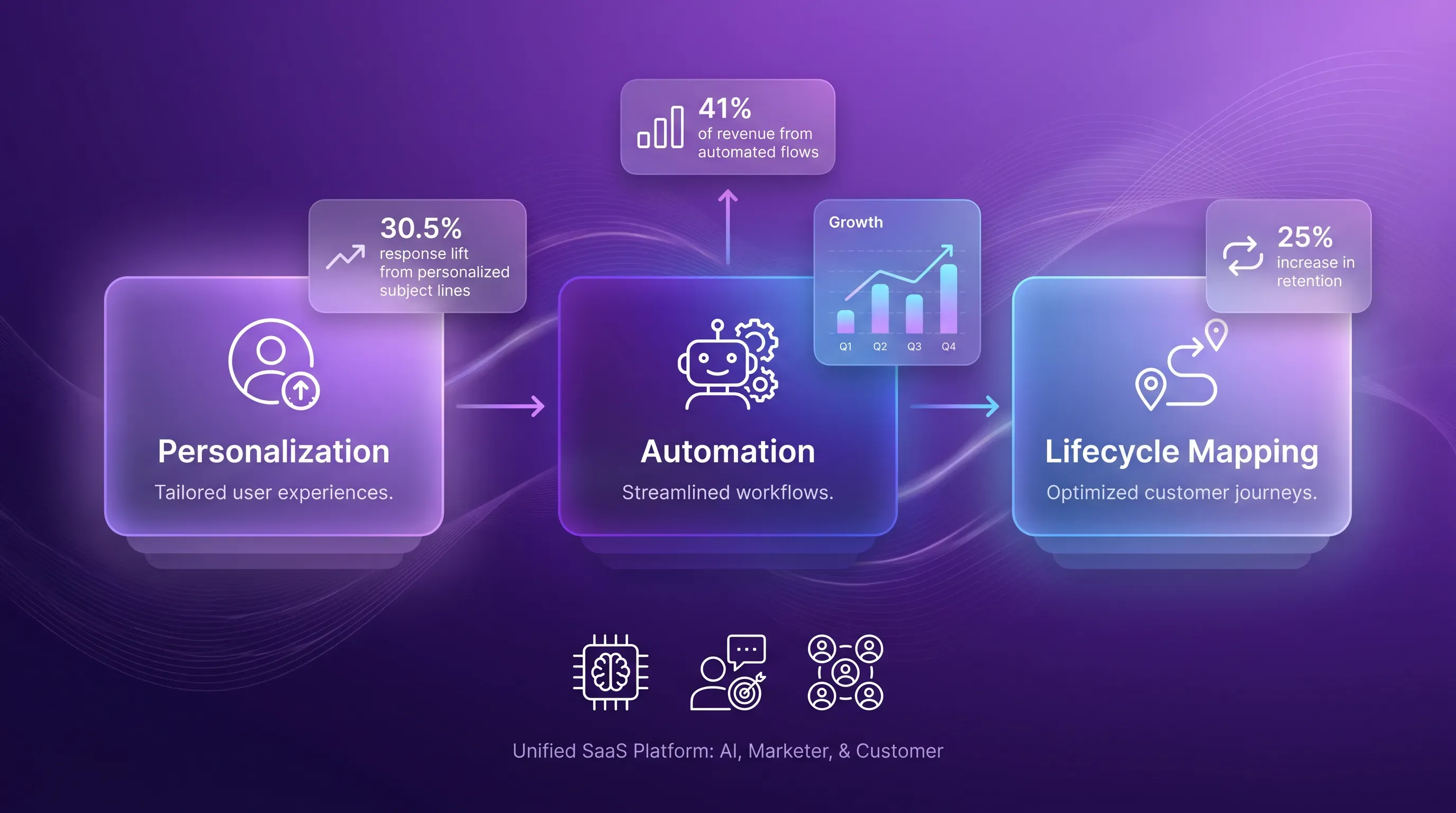
The framework rests on three connected functions: personalization and automation tied to lifecycle mapping. Each one is useful alone, but each one breaks when you isolate it from the other two. Personalization without automation can't scale past a handful of sends. Automation without personalization fires the same rigid sequence at everyone. And both run blind if they ignore where the customer sits in their lifecycle.
AI is the connective tissue that binds them. It applies behavioral signals to personalize content and trigger automated flows, while every decision still routes through an understanding of the lifecycle stage. The point of joining them is revenue. The sections below break down each pillar so you can see how it contributes to measurable growth.
Personalized email campaigns at scale
Personalized email campaigns built on AI go far past inserting a first name into a subject line. The system adapts subject lines, content blocks, product recommendations, and send times to the behavioral signals each contact generates. AI product recommendations alone lift email click rates to 3.75% on average, and to 8.79% for top performers, according to Klaviyo's 2026 benchmarks.
This is the leap past basic merge tags. A merge tag knows a name. A behavioral model knows what someone browsed last week and what they bought six months ago, then uses that context to choose the offer most likely to move them now. In his work on AI-driven email, Brandon Stewart notes that brands that deploy this approach report conversion rates above 60% in their strongest campaigns.
The risk is personalization as a trick detached from real intent. Personalized email campaigns only work when they're grounded in what the customer actually did and wants. Personalized subject lines lift response rates by 30.5%, per a Yes Lifecycle Marketing study, yet only 2% of emails use them, which tells you most brands still treat personalized email campaigns as optional polish instead of the core of the message. Get the intent right and personalized email campaigns feel like service. Get it wrong and they feel like surveillance.
Email automation that responds to behavior
Email automation is the engine that lets personalization scale. The AI layer watches for actions like browsing a product and completing a purchase, with long quiet periods as another trigger, then triggers the right flow at the right moment without anyone touching a keyboard. This is why automated flows generate nearly 41% of total email revenue from just 5.3% of sends, with revenue per recipient close to 18 times higher than one-off campaigns.
There's a real difference between rule-based sequences and adaptive email automation. A rule-based sequence sends email two three days after email one, regardless of what the person did in between. Adaptive email automation reads the signal and changes course. If someone purchases mid-sequence, the system stops pushing the abandoned-cart reminder and switches to a post-purchase flow. That responsiveness is what keeps email automation from feeling robotic.
The payoff is consistency without manual effort. Abandoned cart flows alone generate an average of $3.58 per recipient, the highest of any automation type per Klaviyo, because they catch high-intent buyers at the exact moment they hesitate. Good email automation means every contact gets timely, relevant contact even when your team is asleep, and email automation handles the volume that would otherwise bury a marketer.
Mapping messages to lifecycle stages
The same AI system has to serve different goals based on where the customer sits. At acquisition, the job is earning a first purchase. During onboarding, it's confirming the choice and reducing buyer's remorse. In retention, it's deepening the relationship, and at win-back, it's pulling a dormant contact back before they're gone for good.
Messages should shift in tone and intent as the relationship matures. A welcome email can lead with discovery and education. Post-purchase emails carry some of the highest open rates at a 61% average because they reach people at peak engagement, which makes that moment ideal for encouraging the next purchase rather than restating the pitch. Flows also drive nearly 48% of their revenue from new buyers, which is why welcome and abandonment flows matter so much for first-purchase conversion.
Lifecycle thinking prevents the classic mistake of sending the wrong message at the wrong moment. Pushing a win-back discount at a loyal repeat buyer trains them to wait for discounts. Sending an acquisition pitch to someone who bought yesterday wastes the relationship. Because retention compounds, this stage discipline ties straight to revenue. Returning customers spend 67% more in their third year than in their first six months, according to Bain & Company, so the lifecycle layer is where AI email marketing earns its keep.
Feeding email with your content ecosystem
Email journeys get smarter when they're fed by everything else you publish. Blog posts, lead magnets, product pages, and customer data are not separate from email, they're the raw material the AI layer uses to decide what to send. A reader who downloads a technical guide signals a different intent than one who lingers on a pricing page, and both signals should reshape the journey that follows.
The flow runs in both directions. Content attracts and qualifies a contact, and behavioral data from that content feeds the AI layer before the most relevant assets return to the inbox. A blog post that a segment engages with becomes a natural next email for similar contacts. Bain & Company found that marketing leaders are 1.9 times more likely to align strategy with customer needs rather than channel needs, which is exactly what connecting content to email forces you to do.
This is where discoverability and email intersect. The same content infrastructure that makes you findable in search and AI answers also supplies the signals and assets that power lead nurturing and content distribution through email. Treating the two as one system, rather than a marketing site over here and an email tool over there, is what turns scattered assets into smart journeys.
Measuring relevance and revenue
The only way to know the AI layer is working is to measure past surface metrics. Opens and clicks tell you a message got attention, but they don't tell you whether it moved someone toward a purchase or away from churn. The metrics that prove the layer is an operating system, not a gimmick, sit deeper.
Track these instead:
-
Revenue per contact, which shows whether each person on your list is worth more over time
-
Retention and repeat-purchase rate, the clearest signal that lifecycle messaging is landing
-
Customer lifetime value against acquisition cost, since a 5% increase in retention can boost profits by 25% to 95%, per Bain & Company
These numbers also reveal when something drifts off course. If open rates hold but revenue per contact slips, your personalization is reaching people without matching their intent. If a flow's conversion rate decays over weeks, the automation logic has gone stale against changing behavior. AI email marketing built on the right framework will deliver around a 41% revenue increase from personalization, but only if you measure for it. Measurement is the evidence that AI email marketing is doing real work, and it's how you catch the moment personalized email campaigns or email automation start to slide.
Putting the framework to work
The three pillars and your content ecosystem combine into one revenue-focused system. Personalization makes each message relevant, automation makes that relevance scale, lifecycle mapping aims it at the right moment, and your content supplies the signals and assets that feed all of it. None of these pieces carries the weight alone, which is the whole point of running them as a single AI email marketing layer.
Start by auditing what you already have. Map your existing flows against the lifecycle stages and find the gap, such as a missing win-back sequence or weak onboarding, then layer behavioral triggers and personalized email campaigns onto that foundation before expanding. A sensible first step is one well-instrumented flow you can measure before a full rebuild.
Snoika helps teams connect content and discoverability to measurable growth in one system, which is the same infrastructure that powers smart AI email marketing journeys. If you want to build or audit your own lifecycle program, book a call with our team to map your content ecosystem to revenue at every stage.