Future of AI: What’s Next and How to Prepare

Content authorArtem Lozinsky, EMBA, MScPublished onReading time6 min read
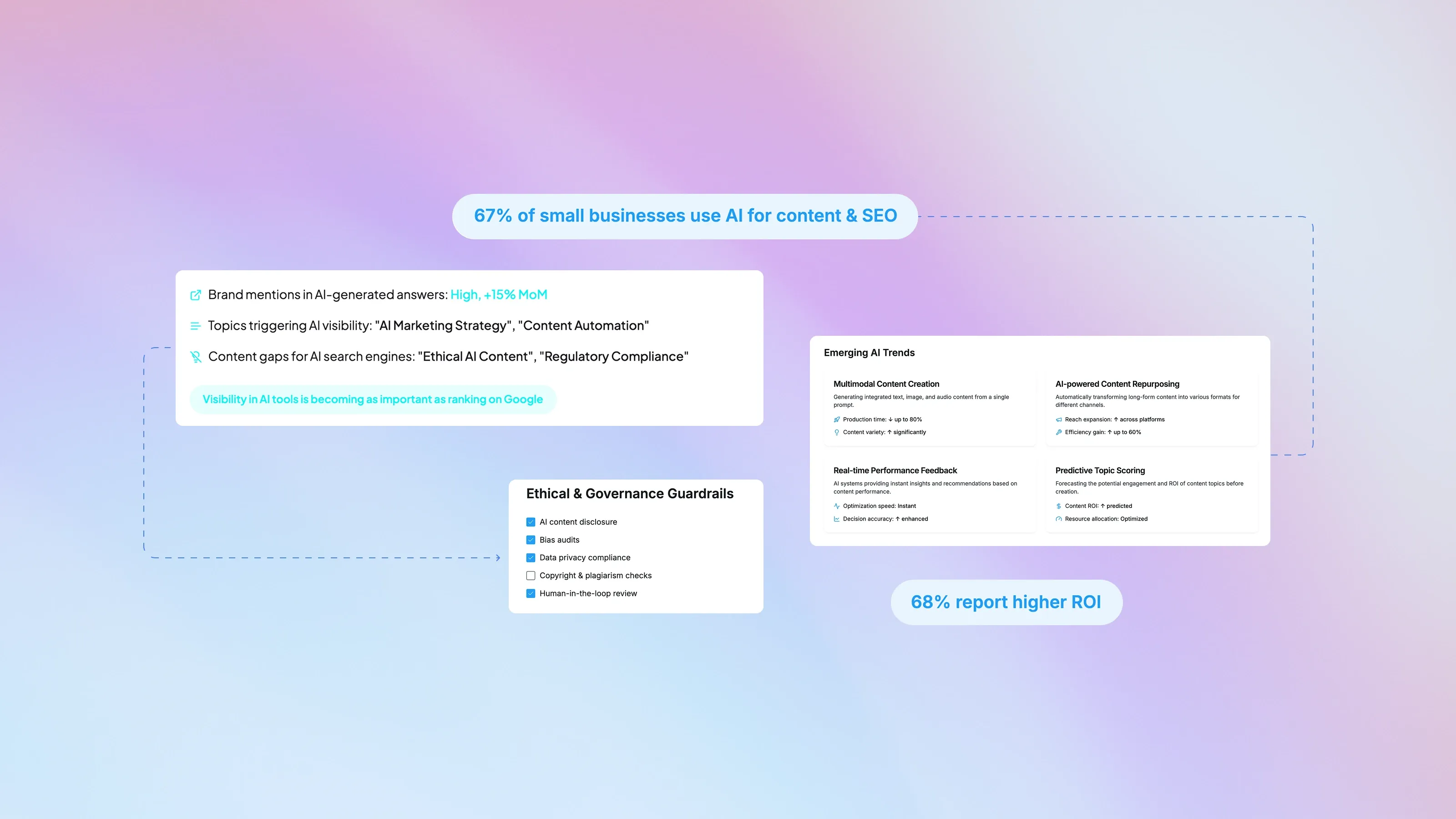
An AI content marketing trends dashboard highlighting AI search visibility, emerging content creation trends, ethical governance guardrails, and higher ROI reported by businesses using AI for content and SEO

What this guide covers?

First, you will see why the promise of AI collides with real-world data gaps.
Next, we unpack the most important trends shaping the future of AI, including generative models, zero-copy data access, and AI search.
Finally, we show practical steps to use AI for marketing, promotion, and decision-making while keeping governance tight.

Expect clear examples, quick lists, and a jargon-free style.

The trust gap edited: Why data quality rules the future of AI and GEO

Ambitious roadmaps crumble when the underlying data is weak. Recent research highlights the scale of the issue.

  • 84 % of organizations say they need a total data strategy overhaul to succeed with AI projects, according to a global poll.

  • 76 % of business leaders feel pressured to squeeze value from data, yet almost 26 % of that data is considered untrustworthy.

  • Nearly half of data leaders admit to making wrong calls because context was missing.

Such cracks explain why 42 % of executives have low confidence in AI outputs. Until quality, context, and accessibility improve, AI will remain impressive in demos but fragile at scale.

Wake-up call delivered, how is the AI field responding?

Key trends steering the future of AI

The next five years will not be about bigger models alone; they will be about smarter integration, efficient access, and responsible rollout.

1. Zero-copy architectures

Traditional pipelines copy data into lakes, warehouses, and sandboxes, multiplying cost and risk. Now more than 56 % of firms are testing zero-copy setups that let AI query data where it lives.

Benefits:

  • Less duplication, so governance stays simpler.

  • Near-real-time insights because data stays fresh.

  • Lower storage bills.

The shift means data engineers must focus on permission layers and query performance instead of endless extract-transform-load cycles.

2. Generative AI meets enterprise controls

ChatGPT and its cousins showed the world what large language models can do. The next wave brings:

  • Fine-tuned models on private data.

  • Audit trails that record every prompt and response.

  • Built-in red-teaming to spot biased or dangerous outputs.

Companies that blend creativity with compliance will outpace competitors that treat generative AI as a gimmick.

Need help with your AI visibility?

Book a free consultation with our experts we'll help you determine exactly which services your organization needs.

3. AI search optimization (AI SEO)

Users increasingly ask ChatGPT, Perplexity, or Google’s AI Overviews rather than type keywords. Visibility now depends on appearing inside AI answers, not just on page one of a results list.

Platforms like Snoika help brands audit whether their name surfaces in AI summaries, then craft content that models can cite with confidence. Expect “algorithm updates” to migrate from search engines to AI assistants.

4. Multimodal and agentic systems

Models that read images, code, and speech in one workflow will unlock richer experiences:

  • Upload a product photo, get marketing copy in seconds.

  • Feed call transcripts, receive churn-risk alerts.

  • Combine code and natural language to automate data cleanup.

Agents that plan tasks across multiple steps will handle routine analytics, leaving humans to verify strategy.

Together these trends push AI from isolated tool to cross-functional partner.

Concluding thought for this section: Organizations that invest now in clean, connected data and robust oversight will harness these advances smoothly, whereas laggards may face expensive re-work later.

Using AI for marketing and promotion: Real-world playbook

AI is already rewriting how brands grab attention, personalize journeys, and measure impact. Below is a simple framework to guide adoption.

Begin with a short reminder: goals first, tech second. AI that chases vanity metrics burns cash.

Audience intelligence

  • Merge CRM, web, and social feeds for a unified view.

  • Deploy clustering models to spot micro-segments.

  • Use sentiment analysis to understand objections before campaigns launch.

Content generation and optimization

  • Draft email copy, ad headlines, and blog outlines with generative AI, then human-edit for tone and accuracy.

  • Train custom models on past high-performing assets to match brand voice.

  • Run A/B tests at scale by tweaking subject lines or visuals algorithmically.

For a hands-on guide to leveraging these tactics, see AI-Powered Marketing: How to Use Artificial Intelligence for Better Results.

AI-powered promotion channels

  • Dynamic bidding tools adjust pay-per-click spend in real time.

  • Recommendation engines surface personalized offers in apps and on sites.

  • Chatbots handle first-touch support, freeing agents for complex queries.

Need help with your AI visibility?

Book a free consultation with our experts we'll help you determine exactly which services your organization needs.

Measurement and loop-back

  • Attribution models reveal which interactions drive revenue.

  • Predictive churn scoring flags accounts needing retention campaigns.

  • Dashboard alerts notify marketers when creative fatigue hits.

Tools such as Find the Right Keywords in Minutes — Not Hours - SEO Optimisation Made Easy provide a data-driven foundation for your campaigns, ensuring your content is always optimized for discoverability, visibility, and measurable impact.

Tools such as Snoika layer an extra lens by tracking whether AI agents mention your brand at critical discovery moments, ensuring your voice is heard where customers now search.

Key takeaway: AI for promotion and AI for marketing are not separate silos. They form one data-driven cycle, continuously refining who you reach, what you say, and how you prove value.

Governance, ethics, and the human factor

No future of AI conversation is complete without responsible deployment. Skipping this step invites reputational and regulatory pain.

  • Establish model cards documenting training data, intended use, and limits.

  • Put humans in the loop for any high-impact decision.

  • Regularly test for bias, drift, and hallucinations.

  • Define clear escalation paths when outputs conflict with policy.

Data stewards, legal teams, and domain experts should meet monthly to review findings and adjust controls. A strong governance framework builds the trust that fuels adoption.

Action plan: Preparing your organization today

Changing culture beats chasing trends. Use the checklist below.

  1. Audit data quality: flag duplicate, siloed, or outdated sources.

  2. Map business goals to AI use cases, scoring each by feasibility and impact.

  3. Invest in upskilling: train teams on prompt engineering, ethics, and basic statistics.

  4. Pilot small, then scale: prove ROI in one function before rolling out company-wide.

  5. Set metrics that align with strategic objectives, not vanity numbers.

For more best practices, including real-world frameworks on AI content creation, read How to Master AI content creation in 7 Simple Steps.

Follow-through is everything. Assign clear ownership, review progress quarterly, and celebrate fast wins to maintain momentum.

Paragraph wrap-up: Companies that treat AI as a cross-departmental capability, backed by solid data foundations, will turn hype into sustained advantage.

Featured snippet: One-paragraph definition

The future of AI refers to the next phase where intelligent systems become deeply embedded across business and daily life, powered by reliable data, zero-copy architectures, generative models, and AI-optimized search. Success hinges on trusted information, responsible governance, and practical applications such as AI for promotion and marketing that tie directly to measurable outcomes.

Conclusion

The future of AI is not some distant horizon. It is already reshaping how data is used, how customers discover brands, and how teams craft strategy. By fixing data quality, embracing responsible innovation, and applying AI for promotion and marketing with clear goals, organizations can ride the wave confidently rather than chase it.

Need help with your AI visibility?

Book a free consultation with our experts we'll help you determine exactly which services your organization needs.

AI models learn patterns from historical information. If that information is wrong, incomplete, or siloed, predictions will also be flawed. Studies show that 26 % of corporate data is untrustworthy and 49 % of leaders have made bad decisions due to missing context, so quality directly affects ROI. Learn more about building data-driven campaigns in [AI-Powered Topic Generator for Smarter Content Marketing](https://snoika.com/solutions/content-marketing).

Focus on free or low-cost generative tools to draft copy and social posts, then use built-in analytics from ad platforms to measure impact. Start with one or two campaigns, learn what works, and scale gradually rather than buying an enterprise suite on day one.

Zero-copy means analytics and AI tools read data where it already lives instead of copying it to new storage. This cuts costs, keeps data fresh, and reduces security risk because fewer duplicates exist.

AI automates repetitive tasks like segmenting audiences or testing headlines, but strategy, creativity, and relationship building remain human strengths. Marketers who pair insight with AI tools will become more valuable, not obsolete.

Platforms such as Snoika scan leading AI assistants to see whether your company is cited in answers. They then recommend content tweaks or authority-building steps to improve visibility. For a deep dive into AI SEO, explore [10 SEO Best Practices for 2025: How to Rank Higher on Google](https://snoika.com/blog/seo-best-practices-2025#section-0).

Schedule a Meeting

Book a time that works best for you

You Might Also Like

Discover more insights and articles

Luminous SaaS dashboard with a deep purple gradient, featuring an 'AI Brand Tracking in LLMs' card and overlapping metric cards.

AI brand tracking for measuring brand visibility in LLMs

This article explains what AI brand tracking is and how to run it as a repeatable process. You'll learn what to measure and how to build a prompt set and metric framework you can report on; the same data also feeds the optimization work that improves your standing inside AI answers.

A vibrant abstract illustration showing 7 distinct AI implementation methods in software development, centered around a glowing AI hub.

7 Ways AI has changed software development in 2026

In 2026 software development is no longer a writing code. Now it is an AI-supported process. AI helps at every stage from planning the architecture to watching the app in production. Big industry surveys prove this. According to the Stack Overflow Developer Survey 2025, 84% of developers already use AI tools or plan to use them (up from 76% the year before). Also, 51% of professional developers use AI every day.

Luminous SaaS marketing illustration featuring a flowchart of six UI cards representing stages in a ChatGPT SEO workflow over a deep purple background.

ChatGPT SEO: A Practical Workflow for Better Visibility

This article walks through a six-stage ChatGPT SEO workflow you can run on every piece you publish. It shows where the model earns its place and where your own judgment stays in charge after dedicated tools confirm the data.

Comparison visual of AI search optimization tools with overlapping cards for Tool A and Tool B, featuring charts and evaluation criteria.

Choosing AI search optimization tools for your team

This article clears up the confusion between AI visibility tools and the keyword trackers you already run, then walks through the criteria that matter when you're buying for a team. By the end, you'll be able to run a fair trial and defend your pick.