6 best ai seo tools for smarter keyword research and content optimization

Content authorJevgenia Pogadajeva, MBA, MScPublished onReading time10 min read
A man in a suit examines a glowing plasma screen with a magnifying glass, set against a deep violet background with dynamic accents.

In this article, I'll compare six AI SEO tools by naming what each one is best at and where it falls short, including how it handles work from clustering and intent through SERP analysis and content decay. By the end, you'll know which fits your research and content optimization needs.

Why tool choice matters now

Most roundups of the best ai seo tools read like the same feature sheet copied six times. Every tool "finds keywords" and "optimizes content," which tells you nothing about which one to actually buy. If you already run keyword research and on-page work for a site, that sameness is the real frustration.

And search itself keeps moving. Keyword research and on-page optimization used to be the whole job. Now there's a third task on the pile: staying visible inside AI-generated answers, since Google AI Overviews cleared 60.32% of U.S. queries by November 2025. A tool has to cover all three or admit it doesn't.

In this comparison, I intend to use one lens per tool. For each tool, I'll identify the strongest use and weaker areas, then examine tools approach from clustering and intent through SERP analysis and the ongoing work of refreshing pages that have lost rankings.

How I compared these tools

Every tool here is judged against the same four capabilities offered by the best ai seo tools, because those are the tasks that eat your week. Here's my criteria:

  • Keyword clustering

  • Search intent detection

  • SERP analysis

  • Refreshing pages

Instead of repeating a generic feature list for each entry, the writeup names one concrete differentiator per tool. I'll explain where that tool is weaker, because no platform wins on all four.

Prices and star ratings change constantly, so nothing here is invented or frozen. Treat the pricing you find on each vendor's site as the real number, and verify current plans before you commit.

6 best ai seo tools

These six split into two camps you'll recognize. On one side are the broad all-in-one research platforms. On the other are the dedicated content optimization and AI-visibility specialists. The right one depends on where your workflow actually stalls.

Semrush for all-in-one research

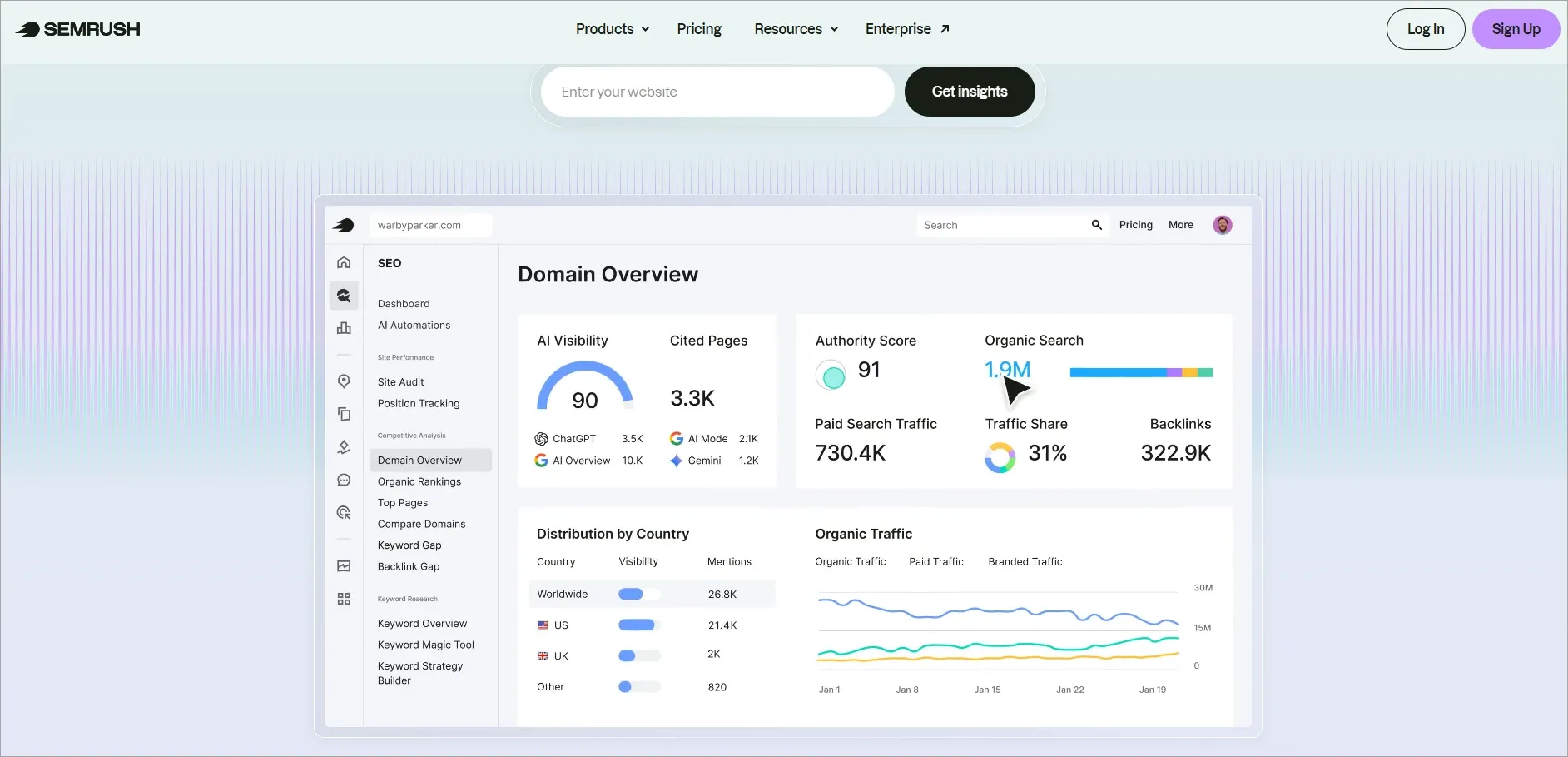
Semrush main page image with dashboard in the middle of the screen.

Semrush's standout is coverage. It pairs one of the largest keyword databases with the ContentShake AI writing assistant. Automatic keyword clustering keeps research and drafting in the same subscription. The Keyword Magic Tool pulls from 27.3 billion keywords across 142 locations and clusters related terms for you instead of leaving you to group thousands of them by hand.

Intent and SERP work are strong here too. The tool tags each keyword for search intent, and it tracks more SERP features than anything else in this list. Its Position Tracking now flags which keywords trigger AI Overviews and estimates the click-through hit, which matters for spotting decay before it bites.

The weakness is honest and well known. Reviewers at TechCognate put it plainly: the interface "tries to do everything and sometimes feels like it is doing nothing elegantly," and new users "spend two weeks just finding where things live." Breadth is the point of Semrush, so it isn't the tightest content editor. Pick it if you want only a keyword research.

Need help with your AI visibility?

Book a free consultation with our experts we'll help you determine exactly which services your organization needs.

Surfer SEO for content optimization

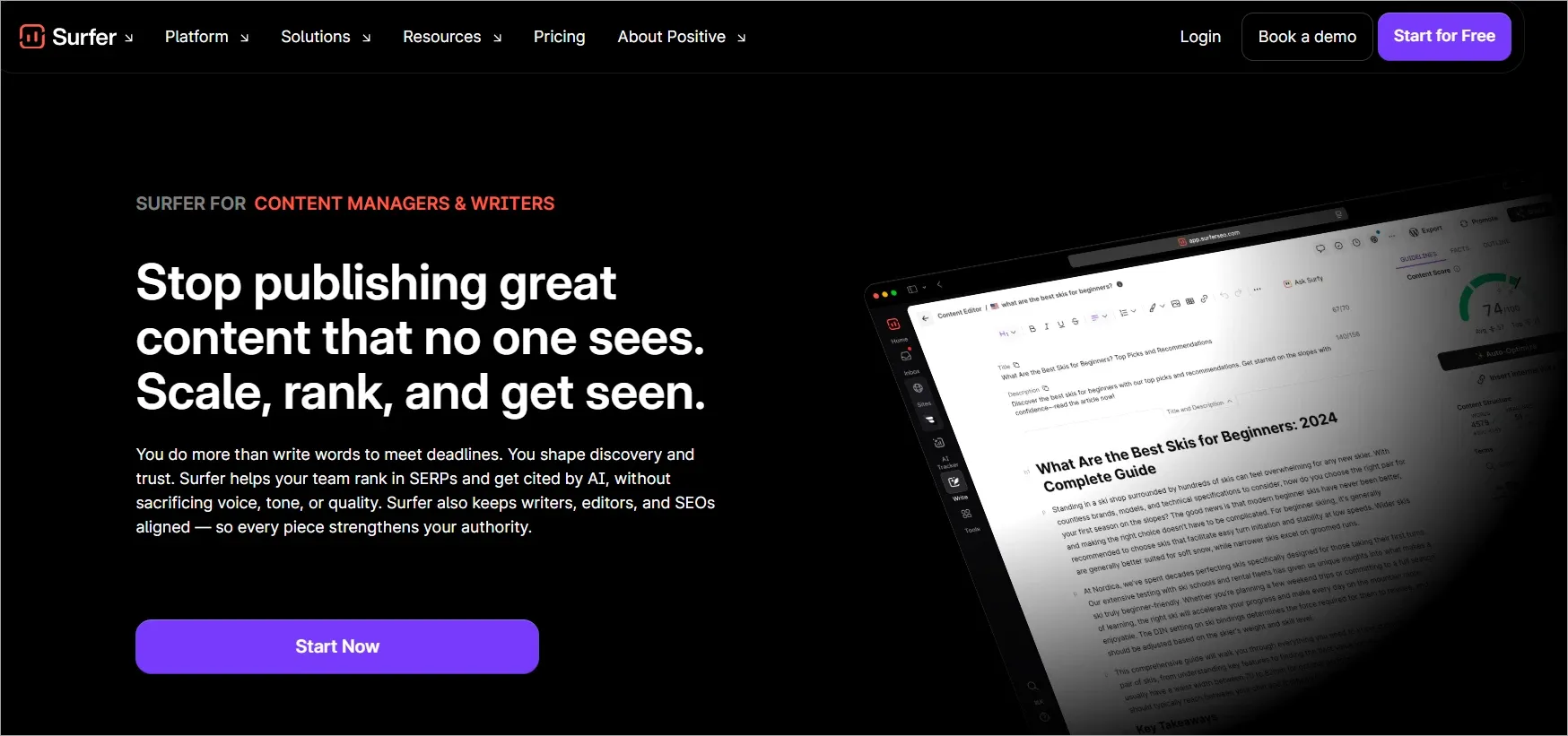
Surfer SEO main page with hero image and description of their services.

Surfer's differentiator is the real-time Content Editor score. You write, and a sidebar shows a 0 to 100 number built from how your draft compares to top-ranking pages. It uses an in-house Natural Language Processing (NLP) engine that Surfer says draws on IBM Watson and Google NLP alongside its own. The engine reportedly analyzes over 500 factors like word count, headings, and NLP term coverage.

This is a dedicated content optimization specialist, strongest at tuning on-page copy against the current SERP. That makes it useful for reviving decayed pages, because you can paste an old article in and see exactly which terms and sections the winners now cover. Surfer's newer AI Tracker adds an add-on layer that monitors brand mentions across five surfaces.

Be candid about two gaps. Surfer has no backlink analysis or technical site auditing, so it isn't a full SEO suite. And chasing a maximum score backfires. As Backlinko's review warns, "the gamification of it can lead to over-optimization," and the advice there is to "aim to meet or slightly beat the average score, not the top score." If you already produce content and want tighter on-page guidance, Surfer is one of the best ai seo tools for that fit.

Ahrefs for ai search visibility

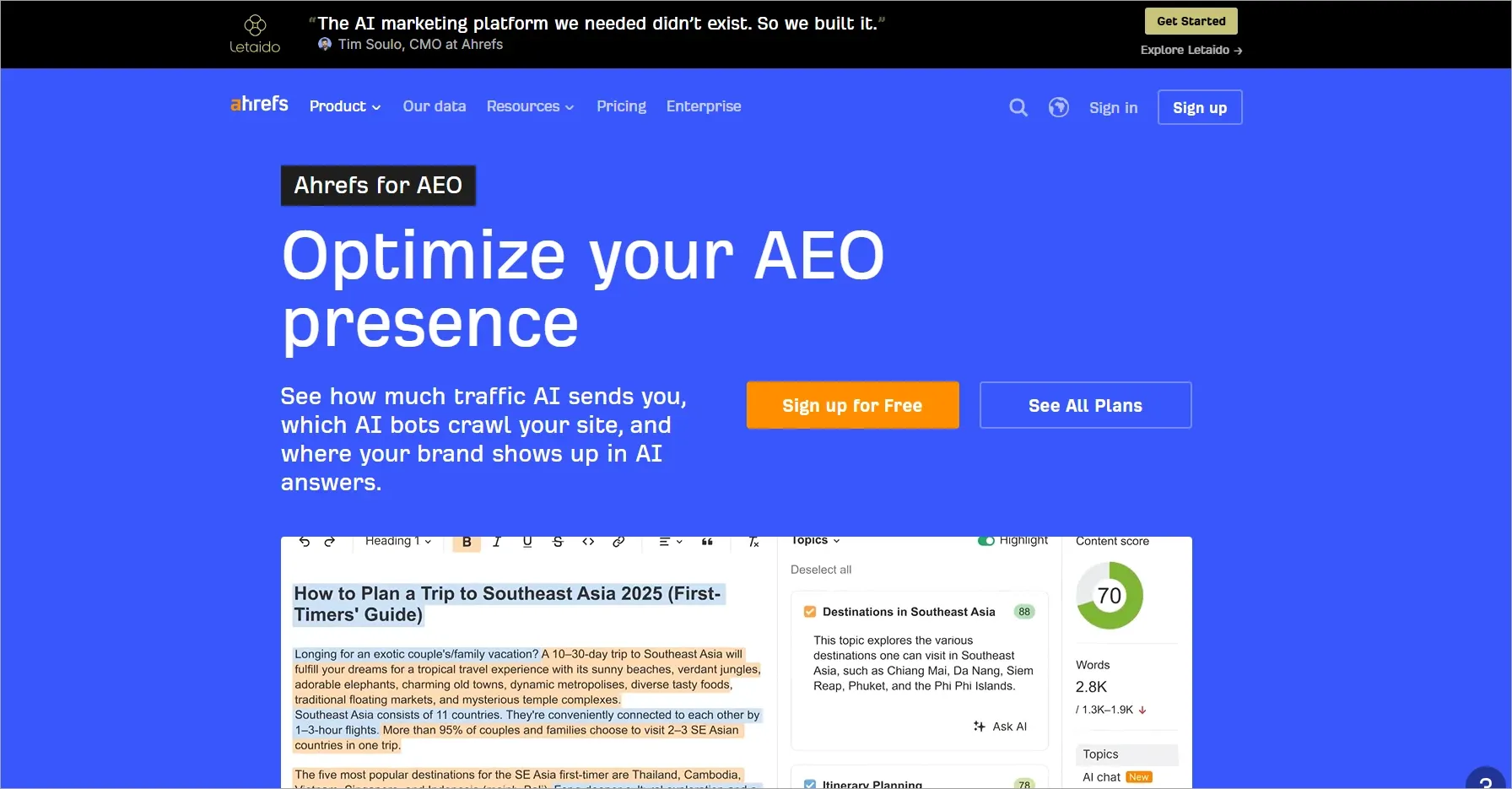
Ahrefs landing page.

Ahrefs leads on data. Its Site Explorer runs on the largest live backlink database at 35 trillion known links across 231 billion indexed pages, fed by AhrefsBot, the second most active crawler on the web after Googlebot. The keyword index holds 28.7 billion filtered keywords from 110 billion ever seen. Content Gap analysis surfaces terms your competitors rank for and you don't.

On the AI front, Ahrefs added a Search Intents column and began showing SERPs with AI Overviews inside Site Explorer in October 2024. Its AI Content Helper went into beta on 14 September 2024. It scores your topical coverage as you write and lets you optimize for a chosen intent without keyword stuffing. That combination pushes Ahrefs into real ai search visibility work alongside traditional rank tracking.

What is it best at among the best ai seo tools? Deep keyword research and competitive intelligence. Where does it trail? Its content optimization is lighter and more post-publication than Surfer's live editor, so the in-draft guidance is thinner. The AI Content Helper still needs a paid plan for more than one document a month.

Reach for Ahrefs when your bottleneck is research and competitive data, especially when ai search visibility matters as much as your Google position.

Moz for intent-led keyword research

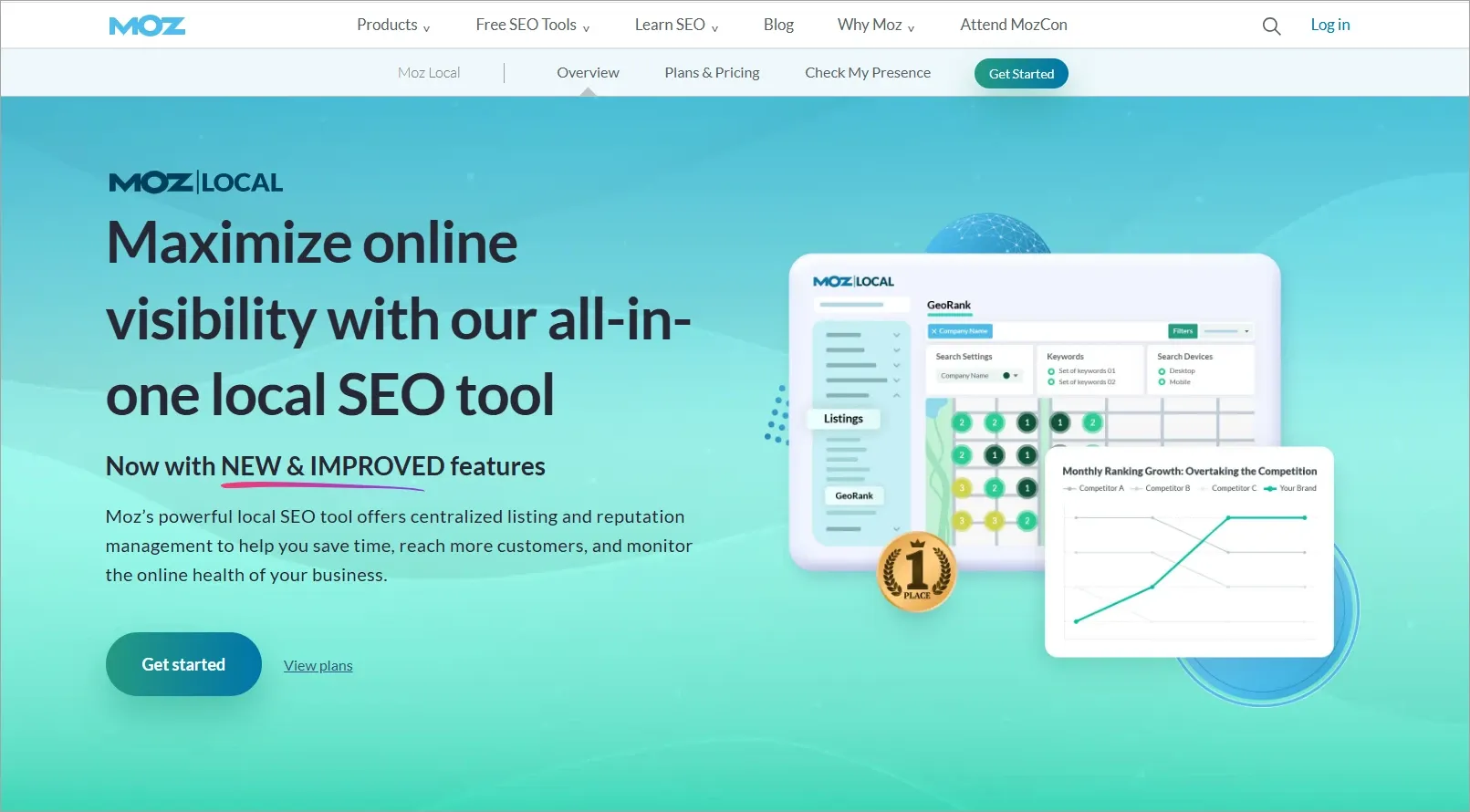
Moz landing page screenshot.

Moz's standout is how it frames priority. The Keyword Explorer wraps volume and difficulty into a single Priority Score that also accounts for opportunity, and Moz co-founder Rand Fishkin explained that a score above 80 signals high demand despite moderate difficulty and competition from SERP features that steal organic clicks. That helps you prioritize keywords according to search intent.

The tool classifies each term by intent, and its SERP analysis pulls volume and difficulty for expanded lists. Moz built its volume estimates on clickstream data from close to a million searchers, which it reports as roughly 95% accurate. For someone building topic coverage around intent, that clarity supports clean clustering and planning.

The honest limit is scale. Moz's database and feature breadth trail Semrush and Ahrefs, so it suits smaller or intent-focused workflows more than exhaustive competitive digging. If you value clear intent signals and a simpler workflow over sheer data depth, Moz earns its spot among the best ai seo tools for that specific job.

Need help with your AI visibility?

Book a free consultation with our experts we'll help you determine exactly which services your organization needs.

INK for on-page NLP writing
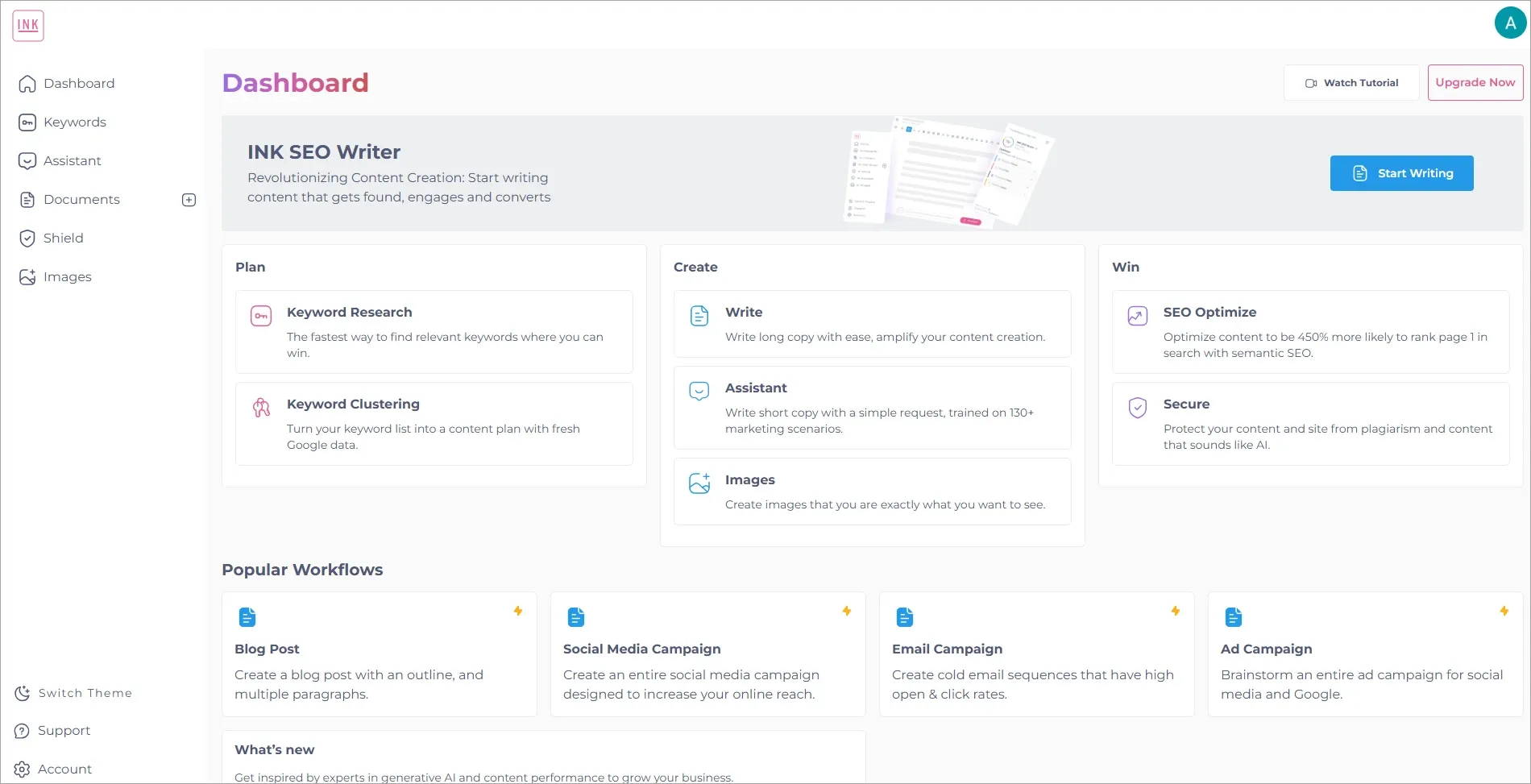
INK main page in their app with dashboard at the top.

INK's differentiator is that it ties semantic on-page writing directly to a cluster strategy. Its Natural Language Optimization writer runs on proprietary NLP and machine learning inside a real-time editor, while the SEO Optimizer checks structure and keyword placement as you draft. Keyword cluster planning sits alongside the writer, so the terms you target and the copy you produce stay connected.

What INK is best at is guiding the actual writing, so a page covers its topic comprehensively and still reads naturally. That's exactly the work of fighting content decay, since reviving a slipping page means rewriting it to match what the current top results now say. INK also folds in plagiarism detection and an AI content check, which cuts the tool-switching that fragments a drafting workflow.

The tradeoff is scope. INK is a writing and optimization specialist, not a full research or backlink platform, so upstream keyword discovery and link analysis live elsewhere. Choose it among the best ai seo tools when your friction is at the drafting and optimization stage.

Snoika for AI visibility
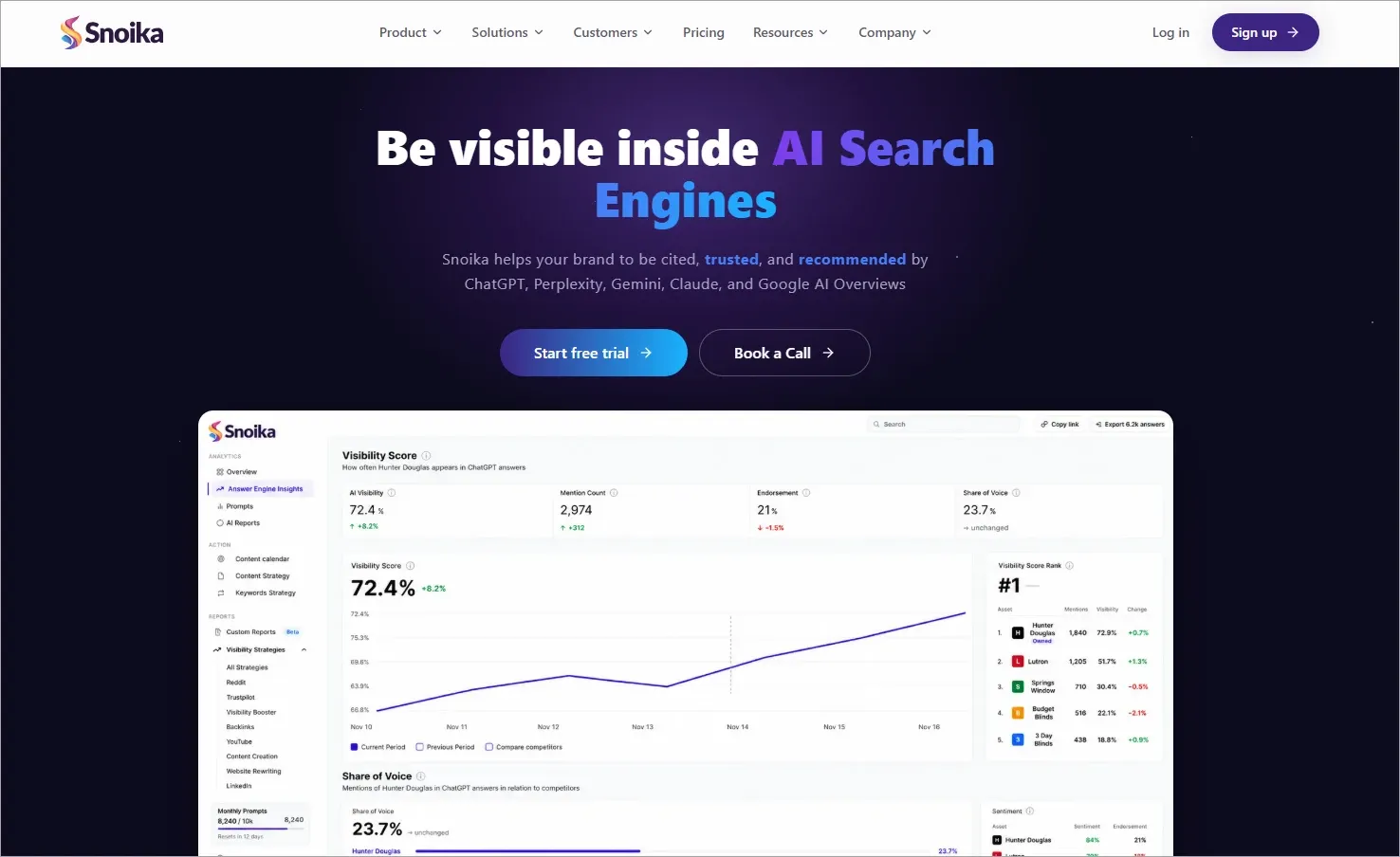
Snoika's main page on their website with dashboard image from the Snoika app.

Snoika's differentiator among the best ai seo tools is consolidation aimed squarely at AI answers. It's a unified AI-visibility and SEO content platform that connects keyword analysis to content production in one workflow, built to get a brand cited in AI answers while still ranking in Google. It runs diagnostics across ChatGPT, Perplexity, Gemini, Claude, and Google AI Overviews with weekly synthetic question testing and entity optimization built in.

The standout is its single system for research through AI-visibility tracking, so a team stops stitching separate tools together. Snoika builds snippet-ready, quotable content and topical authority, and its AI Visibility Score shows how often a brand wins the single answer delivered by these engines. As I said before and keep saying, "Enterprise leaders are realizing that traditional SEO is no longer enough. Snoika shows whether your brand is the answer and gives you the playbook to secure it."

As an all-in-one execution platform, Snoika isn't primarily a deep standalone keyword or backlink database the way Ahrefs or Semrush are. If your need is raw index depth, pair it or look elsewhere.

But for a lean team that wants one connected system for both traditional SEO and AI search, it belongs on any list of the best ai seo tools built for where search is heading. Among generative engine optimization tools, its strength is turning visibility signals into published, citable content.

Matching a tool to your situation

Here's the decision, grouped by the job each tool removes from your plate. Sort your shortlist by your real bottleneck, not by feature count.

  • All-in-one research platforms: Semrush and Ahrefs. Pick Semrush when you want research through drafting in one place, and Ahrefs when link data and competitive intelligence are the hard part.

  • Dedicated content optimization: Surfer and INK. Surfer for live on-page scoring against the SERP, INK for guided semantic writing tied to clusters.

  • Intent-led research: Moz, when clear intent signals matter more than database size.

  • AI-visibility focused: Snoika, plus Surfer's AI Tracker add-on if you only need monitoring. These are the generative engine optimization tools for teams whose brand needs to show up inside AI answers.

No single tool wins on everything, and the honest read is that the best pick is the one that clears your biggest friction. A research-heavy team wastes money on a pure editor, and a content team drowns in an all-in-one suite it barely touches. Both Semrush and Ahrefs now track AI Overviews, so ai search visibility no longer forces a separate purchase if research is your center of gravity. And with pricing shifting across every vendor, confirm current plans directly before you buy.

Worth remembering why this matters at all. Content decay is measurable, a 20 to 40% drop in organic clicks over 8 to 12 weeks on a page that used to perform. The tool you choose makes catching that drop routine.

What to do next

Start a free trial of the one or two tools that match the bottleneck you just identified. Point each one at a real page or keyword set you already care about, especially a page that's losing rankings to content decay, so the comparison runs on your own results instead of a demo. The best ai seo tools prove themselves against your actual work, and the right one is simply the tool that fits how you already move.

Need help with your AI visibility?

Book a free consultation with our experts we'll help you determine exactly which services your organization needs.

Test one real task before you subscribe. The best ai seo tools should help you find terms, judge intent, inspect the current results page, and create an update plan with less manual work. Time the task and compare the recommendations with your existing process before you commit.

Yes, when the two tools have clear jobs. Use the research platform to select topics and assess competitors, then move the approved brief into the editor. Set one owner for the keyword list, since conflicting term recommendations can produce unfocused copy and duplicate work.

Check the exact question and AI engine, then record whether it cites your site or only names your brand. Review the source pages cited beside competitors because they show the format and evidence the engine selected. Re-test the same questions regularly to identify changes.

You need backlink data when a page loses rankings despite a current, complete update. Compare its referring domains with the pages now above it, then inspect whether those links come from relevant sites. Content changes won't close an authority gap if competing pages have stronger link support.

Yes. Snoika is related to this task because it tests whether a brand appears in answers from AI engines and connects the findings to content work. Try Snoika's AI visibility services with a fixed set of customer questions, then assess citations and absent topic coverage before revising pages.

Schedule a Meeting

Book a time that works best for you

You Might Also Like

Discover more insights and articles

Title:
15 best AI tools for SEO ranked for content keywords and competitors

Meta description:
Compare the best AI tools for SEO so you can find keyword gaps and analyze competitors without extra tool

15 best AI tools for SEO ranked for content keywords and competitors

This article ranks 15 best AI tools for SEO based on two jobs: finding worthwhile content keywords and exposing competitor openings. Each entry names one differentiator and the team it suits. Its limitation fixes its place, so you can pick one primary platform and add a specialist only when the data demands it.

A vibrant SaaS marketing visual featuring a central AI hub with glowing icons for ChatGPT, Claude, and Google AI, surrounded by citation nodes and traditiona…

Why ai citations reshape search visibility in 2026

This article explains why a page that ranks well in Google can still go missing inside AI answers, and what that means for ai brand monitoring and how you measure visibility now. It walks through how the major answer engines diverge and why generative engine optimization sits on top of your existing SEO. It also identifies where to start once ranking stops being the finish line.

A blonde woman works on her laptop at a table in a vibrant data center, surrounded by glowing server racks and dynamic workflow icons.

How to use chat gpt seo for competitor analysis

This article gives you one repeatable sequence for running competitor analysis with ChatGPT as part of a chat gpt seo workflow, from building a competitor list to producing a strengths and weaknesses table. It shows exactly where the model helps and where it fabricates. It also shows how to pair it with real ranking data so nothing made-up reaches your client.

A robot climbs a multi-step staircase toward a glowing golden trophy labeled 'SERP', set against a deep violet background.

How to improve ai ranking in search results

This article is a step-by-step guide to earning citations from AI answers like Google AI Overviews and ChatGPT. It also covers Perplexity when you already rank well in classic search. It walks through the work in the order you should do it, from auditing your baseline to tracking whether any of it moved the needle.