
Best keyword research tools
Semrush and Ahrefs are the keyword research tools worth paying for when organic search brings in a large share of your revenue. SE Ranking and Moz Pro give a small team most of that suite for less money. Mangools is the cheapest serious option for one person working alone. A B2B team still testing demand can start free with Google Search Console. And if your buyers now ask ChatGPT before they ask Google, add an AI visibility tracker such as Snoika.
 Artem LozinskyOperations and product, Snoika · 10 min read





















Paid vs free tools
Pay for a keyword tool once your keyword choices decide revenue. Until then, while you're researching one site in one market, free tools will do. Google's free tools give you real data, but only part of it. Search Console lists the queries your site already appears for. Keyword Planner suggests new ones, but it shows exact volume only to accounts that are actively spending on ads. Keywords Everywhere, a vendor whose product is built around that gap, reports that everyone else sees buckets like 1K to 10K.
Paid tools fill in what Google leaves out. They estimate volume for any keyword and score how hard it will be to rank. They also show the terms rival sites rank for that you don't, and no free Google tool reports that. For most buyers, that competitor data is the real reason to pay, more than any single metric.
The price of a paid tool rises with usage limits more than with features. Rankable's 2026 review of Ahrefs plans found that the tier you need depends on how many sites you track. Semrush charges $45 a month per extra user on its Pro plan, so a three-person team pays an extra $90 before anyone runs a report. Before you compare headline prices, count your users and the sites you manage.
What top paid tools offer
For teams that depend on organic search, Semrush and Ahrefs are the two paid tools most worth the money. The other options compete on price or do a narrower job. The table below lists entry plans on monthly billing as of 2026. Annual billing costs less with every vendor.
| Tool | Entry plan (2026) | Strongest at | Suits |
|---|---|---|---|
| Semrush | Pro at $139.95/month | Keyword and paid search data in one suite | In-house teams running SEO and ads |
| Ahrefs | Lite at $129/month | Competitor and backlink research | SEO specialists and content leads |
| SE Ranking | Core at $129/month | Rank tracking with AI search tracking | Freelancers and small agencies |
| Moz Pro | Starter at $49/month | Plain interface and Domain Authority | Small businesses new to SEO |
| Mangools | Entry at $29.90/month | Fast lookups with a difficulty score | Solo marketers and bloggers |
| Snoika | Plans on the pricing page | AI visibility tracking plus content maps | B2B brands measured in ChatGPT and AI Overviews |
Semrush
- Entry plan (2026)
- Pro at $139.95/month
- Strongest at
- Keyword and paid search data in one suite
- Suits
- In-house teams running SEO and ads
Ahrefs
- Entry plan (2026)
- Lite at $129/month
- Strongest at
- Competitor and backlink research
- Suits
- SEO specialists and content leads
SE Ranking
- Entry plan (2026)
- Core at $129/month
- Strongest at
- Rank tracking with AI search tracking
- Suits
- Freelancers and small agencies
Moz Pro
- Entry plan (2026)
- Starter at $49/month
- Strongest at
- Plain interface and Domain Authority
- Suits
- Small businesses new to SEO
Mangools
- Entry plan (2026)
- Entry at $29.90/month
- Strongest at
- Fast lookups with a difficulty score
- Suits
- Solo marketers and bloggers
Snoika
- Entry plan (2026)
- Plans on the pricing page
- Strongest at
- AI visibility tracking plus content maps
- Suits
- B2B brands measured in ChatGPT and AI Overviews
Semrush for the widest toolkit
Semrush suits a team that wants SEO keyword research and paid search data under one login. Pro tracks 500 keywords for rankings but leaves out historical data, which starts on Guru at $249.95 a month. If you need to see how a keyword's rankings moved last year, budget for Guru from the start.
Ahrefs for competitor and link research
Ahrefs is the better pick when you research competitors before you choose keywords. Its link index and Site Explorer show which pages bring a rival the most search traffic. Prices went up in 2026, and PricePulse reports that Lite rose from $99 to $129 in a March restructure. The $29 Starter plan exists, but it's a cut-down product, so check its limits before you treat it as a cheap way in.
SE Ranking and Moz Pro for smaller budgets
SE Ranking used to be the budget suite. Then it retired its $65 Essential plan, and Core now costs about the same as Ahrefs Lite. What you get for that price is daily rank tracking plus AI search tracking. Moz Pro is the cheaper of the two. Its Standard plan at $99 a month includes 50 tracked AI prompts across 4 AI models, alongside 300 tracked keywords.
Mangools for one person
Mangools bundles KWFinder with four smaller tools, and every plan gets the same features. Entry allows 25 keyword lookups a day. That's enough for a blogger planning a week of posts, but it's tight for anyone researching for clients.
Snoika for AI search visibility
We built Snoika as an all-in-one SEO platform with Generative Engine Optimization (GEO) and Answer Engine Optimization (AEO). It audits websites and tracks brand visibility in Google and AI assistants. It also builds researched content maps. It then creates and publishes the pages. The same team runs the platform and the services, and people review the output of the automated workflows. Snoika suits a B2B brand that wants research turned into published pages and measured in AI answers. It costs more than a standalone keyword tool.
Free tools that are enough
Free keyword research tools are good enough for a B2B team while it's testing demand. B2B buyers search in numbers too small for paid databases to measure well. Forecast.ing, a keyword research platform, explains that the clickstream panels behind third-party volume estimates undersample corporate users, and that hits B2B queries hardest. So a paid tool reports zero searches for a phrase your buyers type every week.
First-party data catches what those panels miss. Chima Mmeje, founder of Zenith Copy, told The Gray Company: "I use no-volume keywords all the time. Not every keyword in the funnel has search volume, but I build them anyway if it will be a service/product page to convert traffic from information content." Your Search Console report shows those low-volume queries, and it shows them for your own site.
A free stack that covers early B2B research:
- Google Search Console, for the queries and impressions your pages already earn
- Google Keyword Planner, for new ideas and cost-per-click (CPC) as a signal of commercial value
- The "People also ask" box in Google results, for the questions buyers ask around a topic
- The Mangools free plan, for 5 keyword lookups a day with a difficulty score
- Your sales call notes and support tickets, for the exact words buyers use
Free tools fall short on competitors. None of them shows which keywords bring a rival its traffic. Once a deal depends on beating a named competitor in search, that gap costs you more than a subscription would. We start our own engagements from the same free first-party data. During onboarding we ask for access to Google Analytics 4 (GA4) and Search Console. We also ask for Google Tag Manager access.
Picking by team size
A small SEO team of 2 or 3 people gets the most for its money from SE Ranking Core or Moz Pro. Ahrefs Lite with extra seats added is another good-value option for that team. Which one comes out cheapest depends on seats more than on the plan price. Ahrefs Lite takes up to two extra users at $40 a month each, so three people pay $209 a month. On Semrush Pro, the same three people pay $229.95 once you add two $45 seats. Moz includes 2 users on its Medium plan at $179 a month.
A solo marketer learning SEO fundamentals should start with Mangools Entry plus Search Console, which costs under $30 a month and covers one site well. If you track more than one domain, move to a suite before you hit the daily lookup cap mid-project.
Mid-size teams and agencies end up on the second tier of a major suite. Semrush Guru and Ahrefs Standard at $249 cost nearly the same. Choose Semrush for its data when the same team also runs paid search, or Ahrefs when competitor research drives the content plan.
B2B teams for whom AI answers are a real acquisition channel should look at a different budget line. Snoika's Growth SEO package monitors all AI platforms and adds advanced competitor tracking and a dedicated account manager. Snoika is priced as a marketing program, so compare it against an agency retainer.
ROI signals worth tracking
A paid keyword tool is worth it when the pages it helped you plan earn more than the subscription costs within one or two quarters. At monthly billing, Semrush Pro comes to about $1,680 a year. For a B2B company, a single closed deal from an organic page can cover that. A content site needs thousands of extra visits to do the same.
Measure the tool by the pages it shaped:
- Search Console impressions for new pages in their first 30 to 60 days
- Rankings for the exact keywords you chose with the tool
- Conversions from those pages in GA4, such as demo requests or trials
- Hours saved per content brief compared with your old process
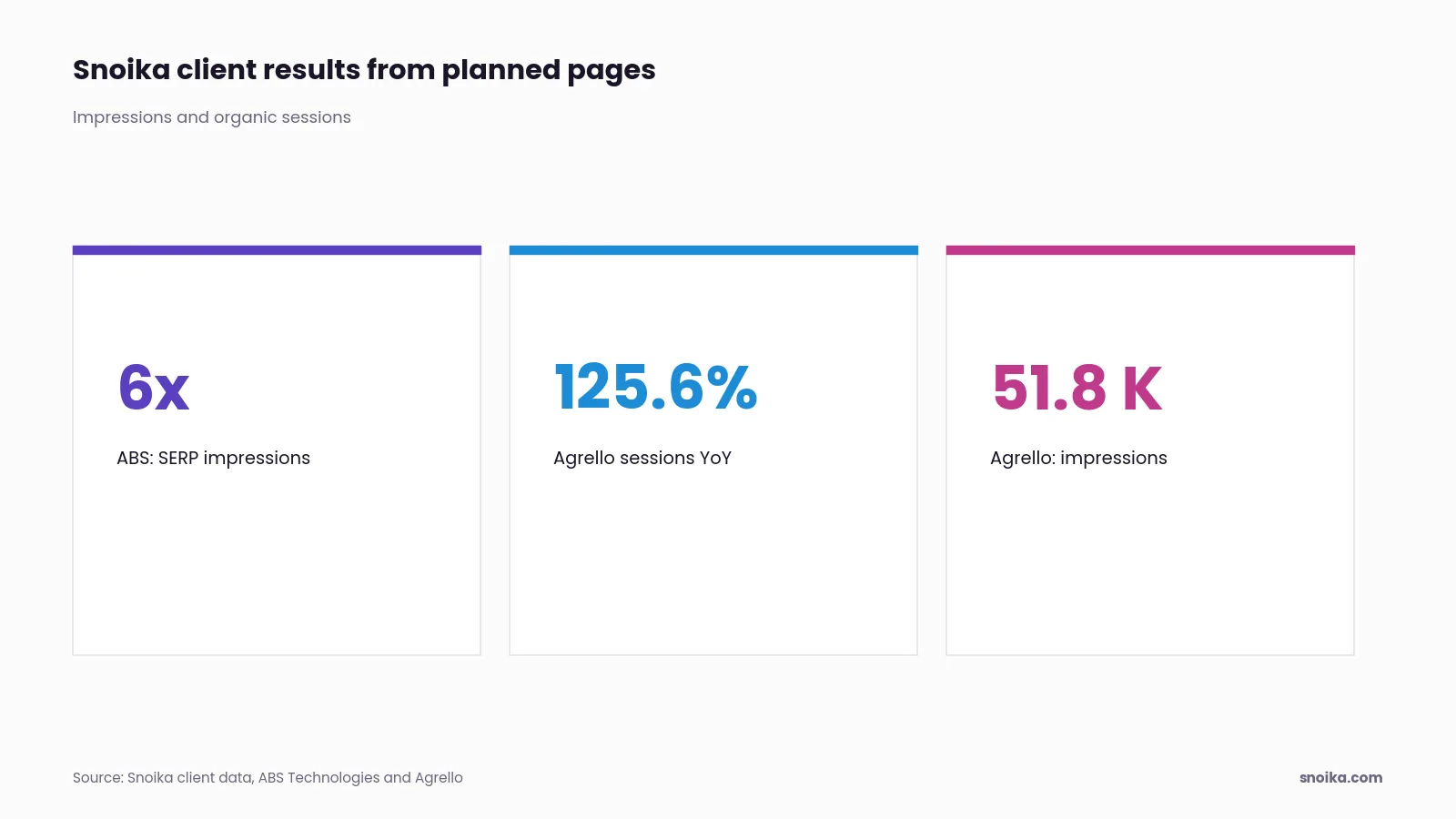
Impressions move first, and that's why they're the early signal. One of our clients, ABS Technologies, got 6x SERP impressions and improved keyword indexability. Its search visibility rose significantly within the first 30 days. Over a longer stretch, Agrello in e-signature recorded +125.6% organic search sessions year over year (YoY) and generated 51.8K impressions from Snoika-created pages.
Attribution works only if the pages sit where your analytics can see them. Through a DNS connection, we publish on the client's own domain. This works on any CMS without a migration. The client approves each page in the dashboard before it goes live. So the impressions show up in the client's own Search Console. If a vendor hosts your content elsewhere, ask how you'll separate its results from everything else.
AI-native features to evaluate
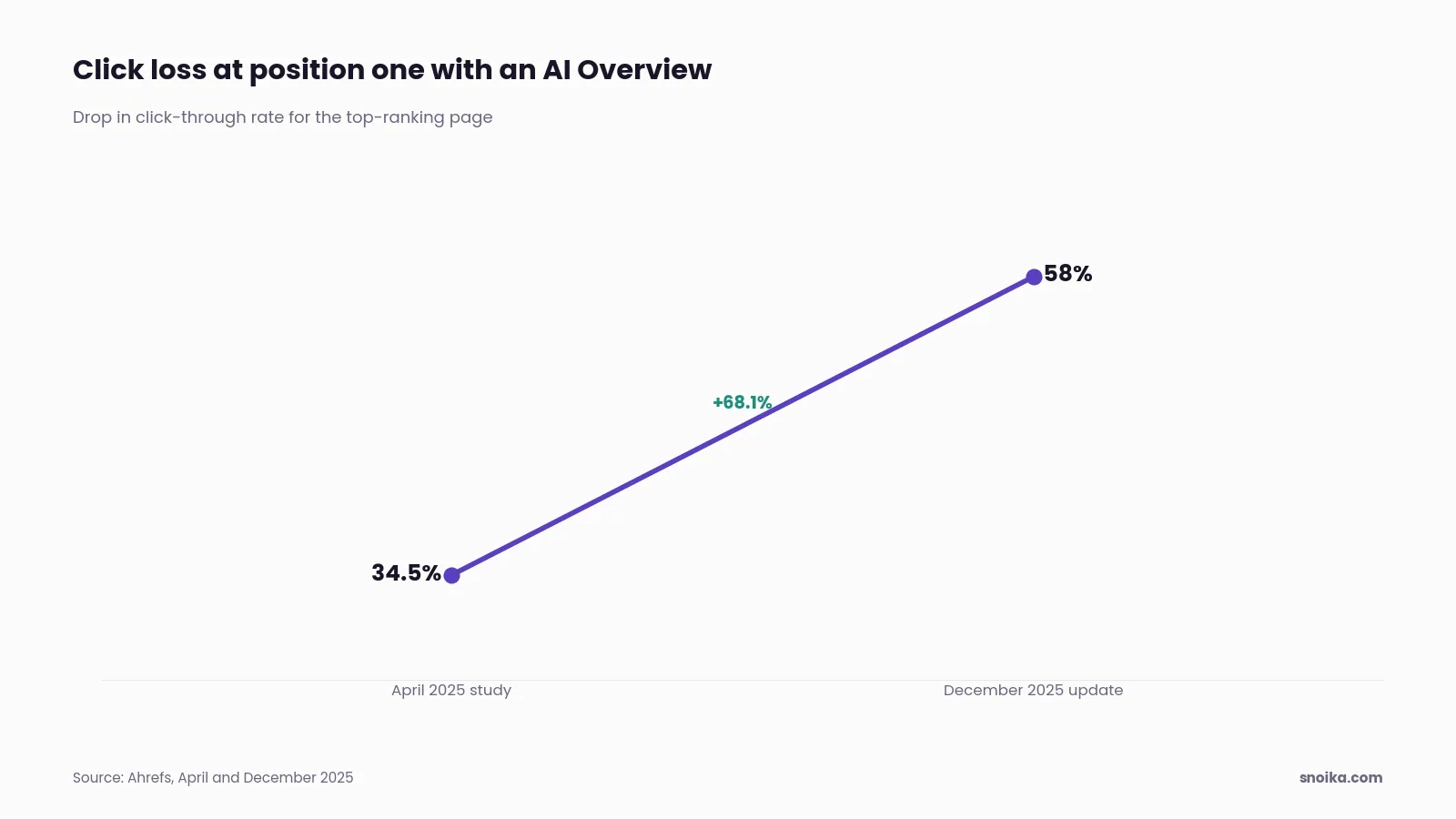
The AI features that matter measure what AI answers say about your brand. Search clicks are moving there. In a December 2025 update, Ahrefs found that an AI Overview cut the click-through rate for the top-ranking page by about 58% at position one, up from 34.5% in its April 2025 study. A keyword can still rank first and send you half the clicks it used to.
When you test an AI feature, check these:
- Prompt tracking, with a fixed set of buyer questions re-run on a schedule
- Citations, meaning which of your URLs the AI answer links to
- Share of voice, meaning how often you appear compared with named competitors
- Sentiment, meaning whether the answer describes you accurately
- Language coverage for every market you sell in
The big suites sell these as add-ons. Semrush's AI Visibility Toolkit starts at $99 a month per domain, and the standalone version includes 25 tracked prompts. Ahrefs Brand Radar costs $199 a month per AI platform, or $699 for all of them, on top of a base plan.
Our own tracking uses weekly prompt sets to measure mentions and share of voice in ChatGPT and Google AI Overviews, where most AI search traffic happens. We also measure sentiment and citations in those answers. 1StopVAT, in tax and fintech, saw 10x growth in ChatGPT visibility in 7 weeks. Whatever you test, also check whether its AI keyword suggestions come from real search data or from a language model guessing. And if you sell abroad, ask how many markets it covers. We create content in 135+ languages and regional variants.
Metrics that actually matter
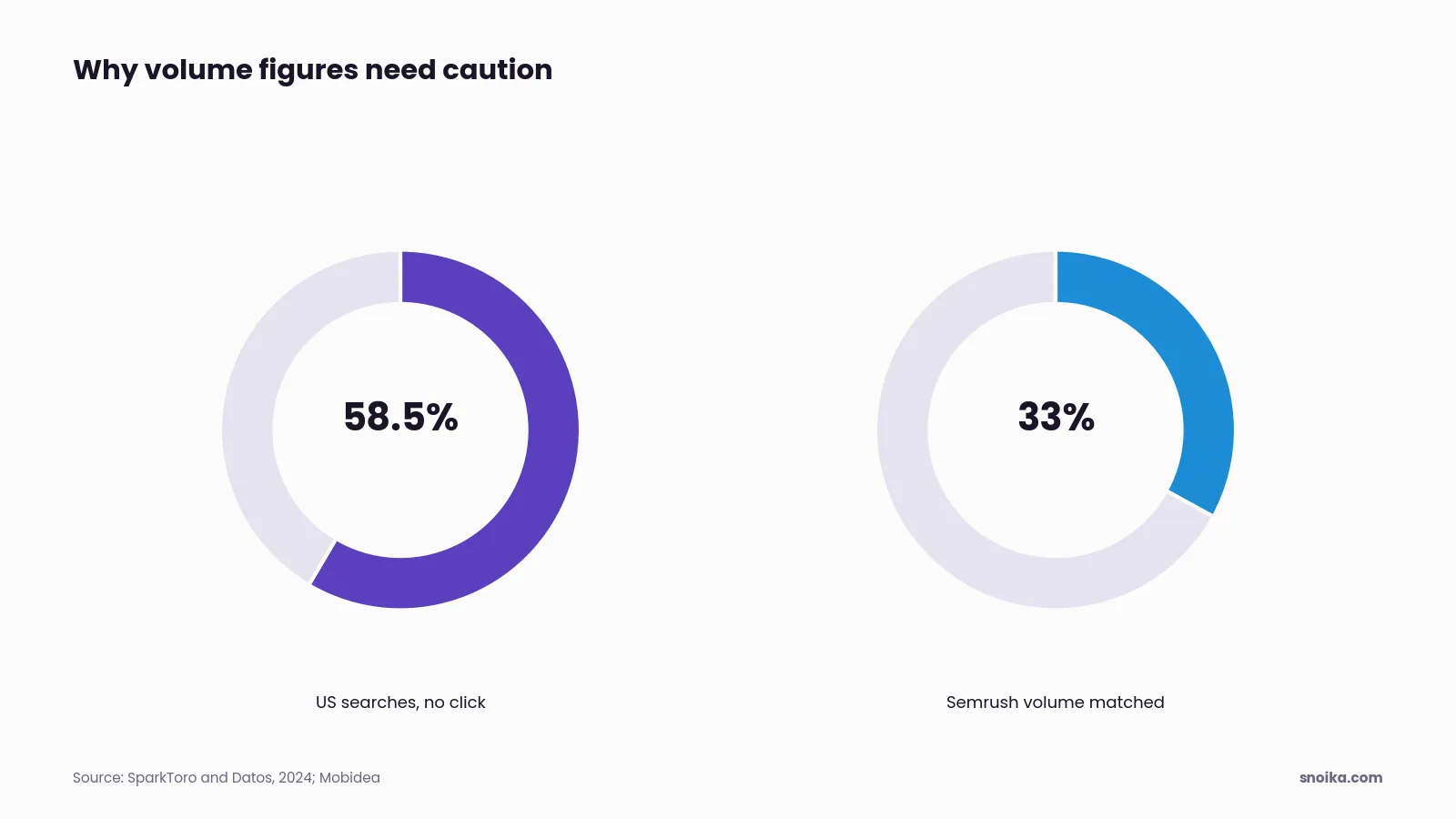
Traffic potential and intent matter more than raw search volume, because every volume figure is an estimate. Mobidea compared tool data with anonymized Search Console figures and found Semrush, the closest match, gave the same volume for 33% of keywords. For the other two-thirds, the numbers differed. Treat volume as a rough sort order and don't build forecasts on it.
Traffic potential gives a better sense of the prize. Tim Soulo, Chief Marketing Officer at Ahrefs, explains how his team calculates it: "we pull the top-ranking page and look up how much total search traffic it gets from all the keyword variations that it ranks for in Google." A page targeting a 200-search keyword can earn far more than 200 visits when it also ranks for the variants.
Keyword difficulty is vendor-specific. A score of 40 in Ahrefs and 40 in Semrush come from different formulas, so compare difficulty only inside one tool. CPC is a quick signal of commercial value: if advertisers pay a lot for a click, buyers are behind that query.
SparkToro and Datos found that 58.5% of US Google searches ended without a click in 2024. Before you chase a keyword, look at its results page. If an answer box already settles the question, the volume figure overstates what you'll get.
Auditing your current stack
Audit your keyword tool stack once a year, before renewals hit. Most teams find they're paying twice for the same data. Work through the stack in this order:
- List every SEO subscription with its renewal date and annual cost. Record its seat count too.
- Pull usage logs and mark any seat nobody has used in 60 days.
- Map each tool to the jobs it does, such as keyword discovery or rank tracking, and flag every job covered by two tools.
- Check which tools cover AI answers, and whether that coverage is a paid add-on you haven't bought.
- Compare each tool's volume figures against Search Console for 20 of your own keywords, then keep the one closest to your real data.
- Cancel the duplicates before renewal, and move the annual saving to the gap you found in step 4.
Step 5 changes decisions because a tool that looks cheaper on the pricing page is wrong about your niche, while a pricier one matches your Search Console closely. Overlap shows up in rank tracking. Teams pay for it inside a suite and again in a separate tracker.
Picking from this list
Run a 30-day test on the 20 keywords that matter most to your pipeline before you commit to a year. Use the free plan or the shortest paid term, and compare each tool's numbers with your own Search Console data, as in the audit above. Pick the tool that's closest to your real data and that covers the competitors you actually lose deals to.
Hold off on annual billing until the test is done. It saves money but locks you in. Mangools charges 35% more on monthly billing for exactly that flexibility. After a month of real use, you'll have more evidence to choose among these keyword research tools than a comparison table provides.
FAQ
Paid keyword research tools are worth considering when competitor research affects revenue. A full suite suits teams that depend on organic search, while a lookup-focused tool can cover solo research. Choose based on the work you'll actually do and the usage limits you'll need.
A suite with enough included seats can fit a small team's budget better than a cheaper entry plan. The listed options include $179 monthly for two users and $209 for three. Compare total seat costs and site limits rather than headline prices.
A paid tool earns its cost when the pages it helps you plan generate more revenue than the subscription within one or two quarters. Track conversions from those pages and time saved on content briefs. Early impressions show progress, but they don't establish profitability.
Yes, free tools can cover early demand testing for one site in one market. Use your site's query data alongside sales notes to find buyer language that paid databases may miss. Paid competitor research becomes useful when you need to identify terms bringing rivals traffic.
Run a 30-day test using 20 keywords that matter to your pipeline. Compare the tool's estimates with your own search data and check its coverage of relevant competitors. Use a free plan or the shortest paid term before committing to annual billing.


