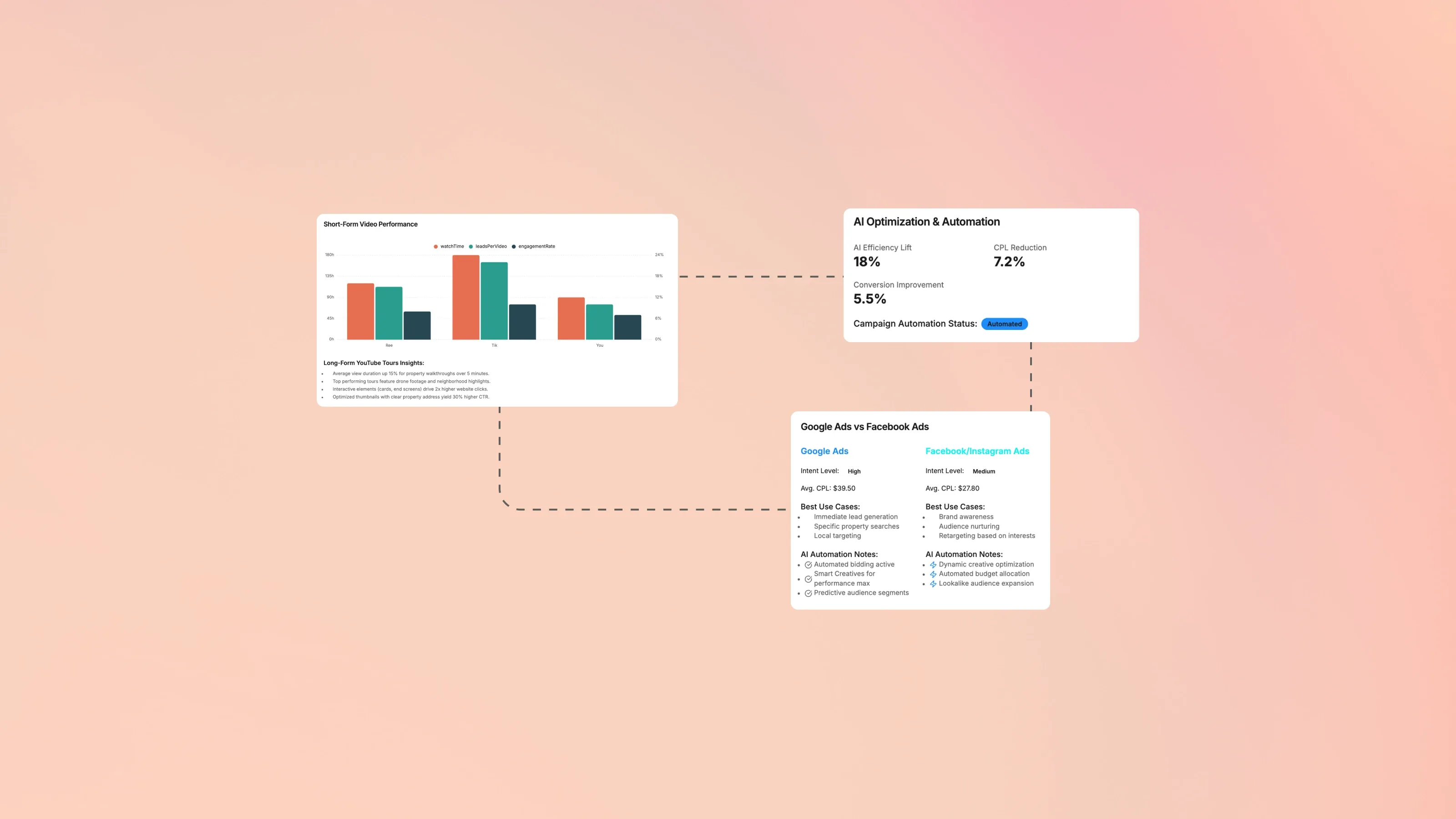
Marketing analytics dashboard showing video performance metrics, AI optimization impact, and a comparison of Google Ads versus Facebook Ads for real estate campaigns.

Real Estate Advertising Strategies That Work in 2026

Homebuyers now search with ChatGPT, browse listings on Instagram Reels, and expect instant answers. Agents who still rely on yard signs feel invisible. The core question: which channels, tactics, and tools actually generate showings and signed contracts in 2026?

Content authorJevgenia Pogadajeva, MBA, MScPublished onReading time7 min read

Overview

In this guide you will learn which digital platforms deliver the lowest cost per lead, how Google Ads stack up against Facebook Ads, and why video plus real estate AI advertising have become non-negotiable. Real-world numbers, short lists, and agent case studies make every section quick to apply. In this guide, you’ll learn which digital platforms deliver the lowest cost per lead, how Google Ads compare to Facebook Ads in terms of quality and price, and why video marketing and AI-powered real estate advertising are now essential. With real-world numbers, quick actionable tips, and agent case studies, you’ll get practical insights you can use immediately as we explore the best platforms for 2026, the strengths of each channel, how short-form video and virtual tours drive results, and the exact steps to turn these strategies into leads fast.

Why Digital Matters More Than Ever

Roughly 82% of Americans already use AI for housing market information. If your ad strategy cannot appear in these data-driven moments, another agent’s brand, listings, and expertise will take that space instead. Meanwhile, the global AI market for real estate is on pace to hit $1,047 million by 2032, so every marketing dollar you invest today compounds.

Digital advertising is no longer just about getting seen; it’s about positioning yourself where people and algorithms are already looking, and doing so with precision, relevance, and scale. To do that effectively, you need to understand which channels actually deliver results. Let’s start with the platforms.

Best Digital Platforms for Real Estate Ads

Digital channels are multiplying, yet three remain the backbone for predictable closings.

Those are the ones every serious agent should prioritize:

  • Google Search: Google still commands intent traffic. A prospect typing “2-bedroom condo Dallas downtown” is moments away from booking a tour.

  • Facebook & Instagram: Meta’s targeting layers, plus Marketplace placement, let you micro-segment homeowners and renters by life stage and zip code.

  • YouTube & TikTok: Short videos invite buyers to feel the space. With AI captions and analytics, you learn instantly which scenes drive inquiries.

Other channels to test:

  • X (formerly Twitter) Promoted Posts for local buzz

  • LinkedIn Sponsored Content for commercial listings

  • Reddit Ads in local subreddits for off-market deals

By mixing Google’s pull with social push, agents cover both active and passive buyers. Transitioning, how do Google Ads and Facebook Ads compare head-to-head?

Google Ads vs Facebook Ads for Real Estate

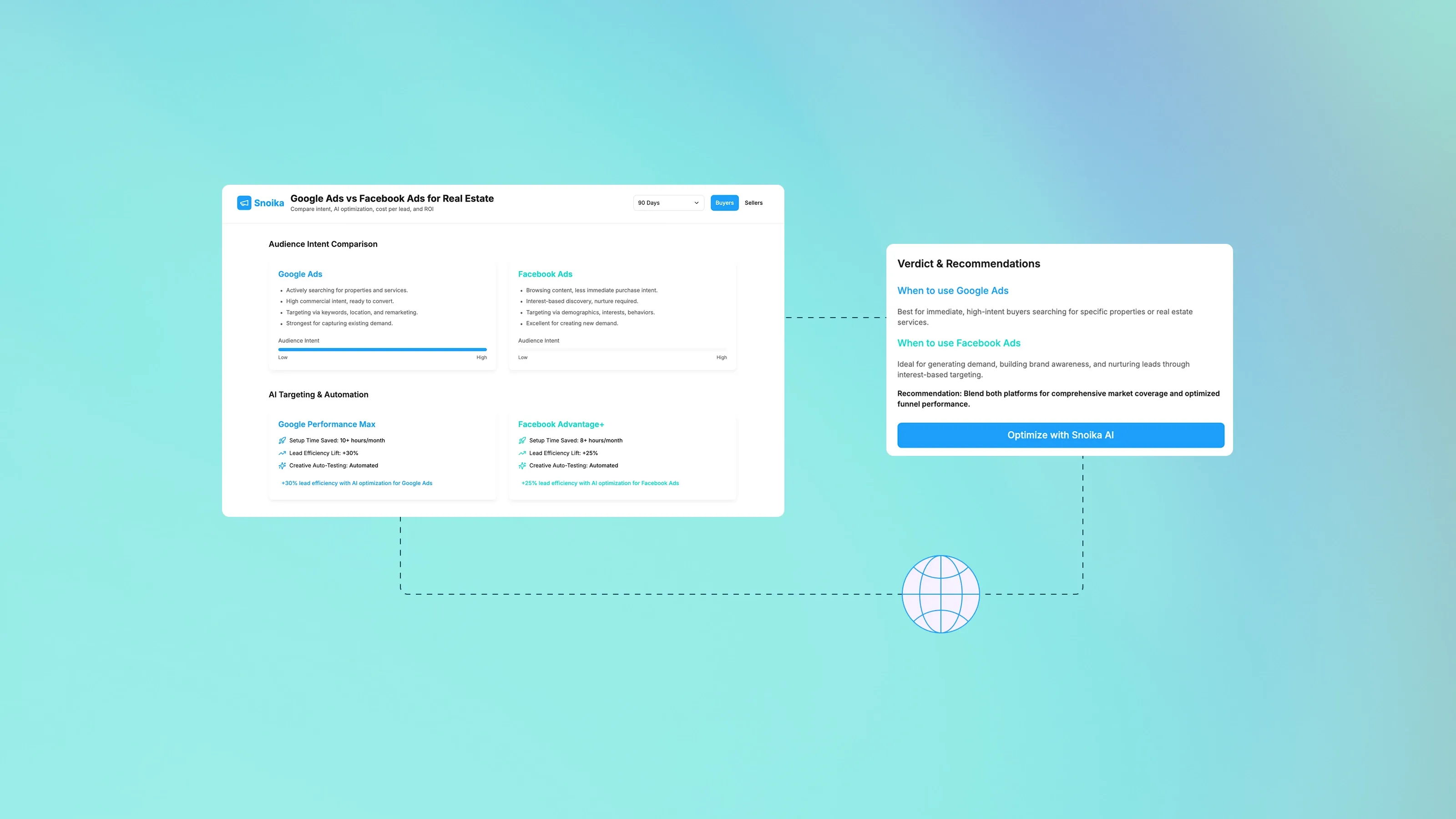
AI-powered marketing dashboard comparing Google Ads and Facebook Ads performance with automated recommendations for real estate lead generation

Both platforms now bake AI into bidding, creative, and audience discovery. Yet their strengths differ. Below is a balanced look at objectives, costs, and tools.

1. Audience Intent

Google Ads meet users who are already searching. That urgency often converts at a higher rate, but keywords like “homes for sale Miami” can be pricey.

Facebook Ads intercept users scrolling news feeds. Intent is lower, yet you can spark desire with compelling visuals and retarget visitors for pennies. Pair Google for bottom-funnel buyers with Facebook for top-funnel nurture.

2. AI Targeting & Automation

Google’s Performance Max uses real estate AI advertising to automatically place your listings across Search, Maps, YouTube, and Gmail, learning over time which assets generate the most calls and inquiries. Meanwhile, Facebook’s Advantage+ campaigns apply AI-driven optimization to test different images, captions, and audiences on the fly, reducing guesswork and cutting down the need for constant manual adjustments. Both AI systems slash setup time. The typical agent using AI tools saw lead generation efficiency rise by 30%.

Explore deeper insights, automation features, and real case studies in Real Estate Advertising That Moves the Market.

3. Cost per Lead (CPL)

Numbers reflect 2024–2025 U.S. averages based on brokerage media audits. On Google Ads, typical cost per lead ranges from $30–$80 for buyers and $50–$120 for sellers, while Facebook Ads generally delivers cheaper leads at $10–$40 for buyers and $25–$70 for sellers. In short, Google tends to cost more because its users show higher intent and are closer to taking action, whereas Facebook usually offers lower-cost leads at higher volume with greater budget flexibility.

4. Ad Formats That Convert

To get real results, you need to pair each platform with the ad formats that match user intent.

These proven options deliver strong engagement and conversion:

Google

  • Search Text Ads for motivated buyers

  • Local Service Ads with pay-per-call

  • YouTube Pre-Roll featuring quick home tours

Facebook

  • Carousel Ads highlighting multiple rooms

  • Lead Forms pre-filled with profile info

  • Reels and Stories for vertical walk-throughs

5. Proof in Action: Blending Platforms for Better ROI

The Rivera Team in Phoenix spent $3,200 on Google Ads last quarter. Performance Max optimized automatically, netting 22 booked showings and 3 closings, a cost of $1,067 per sale.

In parallel, they invested $1,900 in Facebook Advantage+ campaigns. Reels showcasing backyard pools generated 380 leads, 14 showings, and 2 closings, a cost of $950 per sale. Lessons: Facebook delivered cheaper leads; Google produced slightly faster conversions. Blend both to hedge.

6. Verdict

Use Google Ads when your MLS inventory matches popular search terms and you need immediate calls. Lean on Facebook Ads to fill your database, promote open houses, and re-engage past visitors. Together, they form the most resilient pipeline.

Before moving on, remember that AI optimization now determines visibility across both networks. Tools such as Snoika, which ensures brands appear in AI-generated answers on ChatGPT and Perplexity, help agents remain present even when buyers bypass traditional search.

For a closer look at integrating both brand awareness and measurable results, see Brand Marketing vs. Performance Marketing: Which One is Right for You?.

Video Marketing for Real Estate: 2026 Essentials

Video is no longer optional. Platforms reward motion and captions, and buyers crave realistic previews.

Introductory tip: record vertically first, then crop to horizontal for YouTube. AI editors can complete the process in minutes.

Short-Form Clips (0:15-0:60)

Focus your videos on what buyers care about most - highlight standout kitchens, great views, or attractive community amenities. Add auto-generated captions so the message still lands when people scroll with the sound off. And don’t forget to use TikTok’s “Nearby” feed to reach local movers right where they are.

Long-Form Tours (2-6 minutes)

Narrate the flow of the home, mention square footage, and answer FAQs on-screen. Upload to YouTube and embed on listing pages. Google often ranks these videos on the first page.

Live Video & Streaming

Facebook Live open houses let remote buyers comment in real time. Pair with automated reminders and retarget viewers later.

If you’re developing high-volume, high-engagement video strategies, learn how agencies optimize, automate, and scale video and blog content in How to Master AI Content Creation in 7 Simple Steps.

Concluding thought: agents adopting video combined with AI writing tools rose to 87% using AI overall, so staying silent on video risks falling behind.

5 Keys to Real Estate AI Advertising Success in 2026

AI isn’t just a trend anymore; it’s shaping how buyers discover agents, view listings, and decide who to trust. To stay competitive, your strategy needs to blend automation, smart targeting, and engaging creative.

Here’s what matters most in 2026:

  • Start with Google Performance Max for high-intent traffic.

  • Layer Facebook Advantage+ to capture scroll-stage buyers.

  • Film 30-second vertical videos for Reels, TikTok, and YouTube Shorts.

  • Use AI writing assistants for listing copy, saving the 71% of agents who cite ChatGPT as their favorite tool.

  • Track AI visibility with platforms like Snoika to ensure your brand appears in ChatGPT answers, not just search results.

Follow these fundamentals and you’ll build a marketing engine that attracts attention today while staying ready for where AI-driven real estate is heading next.

Conclusion

In 2026, success hinges on appearing where buyers ask AI for advice, scroll social feeds, and click intent-driven search ads. Combine Google Ads for immediacy, Facebook Ads for scale, and video for emotional pull. Layer real estate AI advertising tools, from Performance Max to visibility platforms like Snoika, to keep your name in the conversation even when the conversation happens inside a chatbot. Test, measure, and refine monthly. The agents who master these channels today will own tomorrow’s closings.

Begin with 10% of expected gross commission income or at least $600 per month. Split 60% to Facebook for volume and 40% to Google for ready buyers. Adjust monthly based on CPL and closing ratios.

Yes. Local Service Ads place you at the top of search with a “Google Screened” badge and pay-per-call pricing. Brokers report higher seller lead quality compared to standard search ads.

AI auto-tests images, headlines, and audiences faster than humans can. As a result, campaigns using AI targeting experienced 30% higher lead generation efficiency.

Absolutely. TikTok’s detailed interest targeting and location filters let you promote $1 million homes to local high-income users. Pair with drone footage for maximum impact.

Watch cost per lead, lead-to-showing rate, and cost per closed deal. If CPL rises above your margin, refresh creatives or narrow targeting.

Schedule a Meeting

Book a time that works best for you

You Might Also Like

Discover more insights and articles

A product feed quality dashboard displays an 88% feed quality score with attribute completeness, policy compliance, identifier accuracy, and shopping ads performance funnel metrics

Product Feed Optimization for Ecommerce Performance

Many online retailers face a frustrating reality where they have excellent inventory, but their shopping ads fail to generate clicks. The issue often lies not in the product itself, but in how the product data is communicated to search engines and marketplaces. Without clear, structured data, algorithms cannot match your items with the customers looking for them.

An affiliate marketing analytics dashboard displays a click-to-commission funnel, conversion distribution, and revenue by channel charts

Affiliate Marketing Explained: A Performance Channel Breakdown

Affiliate marketing keeps growing, yet many teams still wonder how it really fits into a modern performance mix. How does the money flow, who gets paid, and when is the channel worth the effort? That is exactly what we will unpack here.

A customer acquisition dashboard visualizing CAC to LTV ratio, retention trends, spend versus customers, and budget control rules for data-driven growth optimization

How to Reduce CAC with Smarter Performance Marketing

Customer acquisition costs are climbing fast. If you do nothing, every new customer will eat a larger slice of your budget. The good news: thoughtful performance marketing can rein that spending in and keep growth on track.

In this guide, you will learn exactly what CAC is, why it often spirals, and the practical moves that bring it back down.

An AI-powered marketing dashboard visualizes campaign structure, conversion performance, and account health score to optimize digital advertising efficiency

Facebook & Instagram Ads: Best Practices for 2026

Social media advertising keeps getting pricier and more crowded, yet the brands that refine structure, creative, and targeting continue to scale profitably. What will separate winners and also-ran campaigns in 2025?