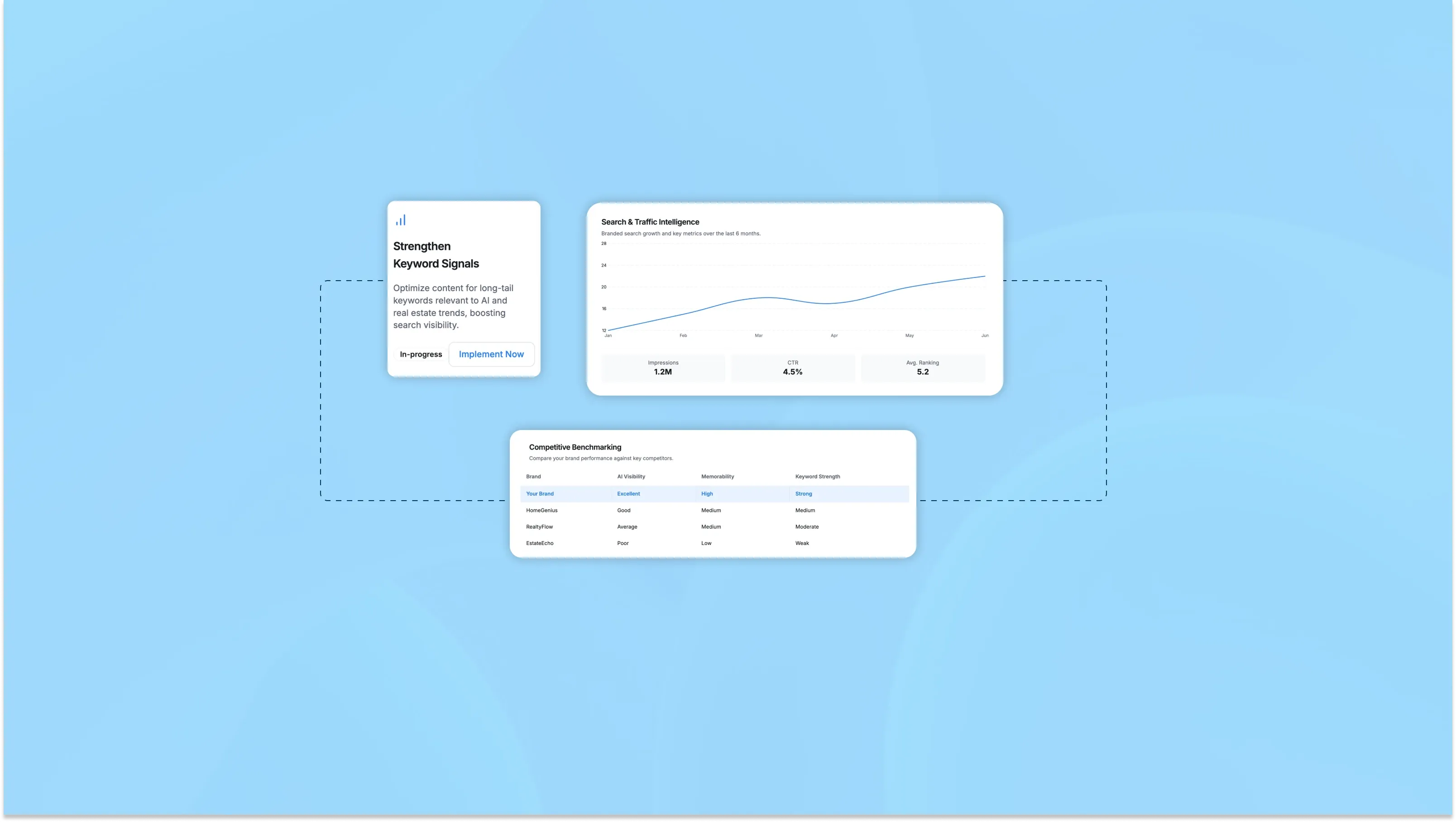
AI marketing dashboard showing keyword signal optimization, search traffic growth, and competitive benchmarking for brand visibility

How to Choose the Perfect Business Name for Your Real Estate Brand

AI search is changing how buyers, sellers, and investors discover companies. If your name is bland or confusing, those algorithms will rank you lower and prospects will skip right past you. Ready to give your real estate venture a name that pops both with humans and machine learning models? Let’s get started.

Content authorArtem Lozinsky, EMBA, MScPublished onReading time7 min read

Overview

This guide helps real estate brands choose a name that actually works in today’s AI-driven world. It shows how to come up with strong ideas, check that they’re legal and easy for both people and AI to understand, and make sure the name can grow with your business. It also explains how to launch your new name the right way and track whether it’s really helping your visibility and results.

Why Your Real Estate Brand Name Matters in an AI-First Market

The right name is no longer just a logo; it's metadata that feeds AI chat answers and voice assistants.

Some numbers:

  • 87% of brokerage leaders say their agents rely on AI tools, so a clear, searchable name is essential.

  • 82% of Americans now ask ChatGPT or Gemini for housing info, and those chatbots surface brands with strong entity signals.

  • In branding circles, 69.1% of marketers added AI to their toolkit last year, proving that machines increasingly decide which names clients recall.

A crisp, keyword-aware name increases click-through rates, listing views, and even perceived expertise. Think of “Opendoor” or “Roofstock”, both hint at property focus while being algorithm-friendly.

If your goal is to ensure your real estate advertising stands out and ranks, check out Real Estate Advertising That Moves the Market. This guide covers how platforms like Snoika help you scale visibility and growth with digital marketing and business name ideas made for the AI era.

Brainstorming Session: Generating Unique Name Ideas

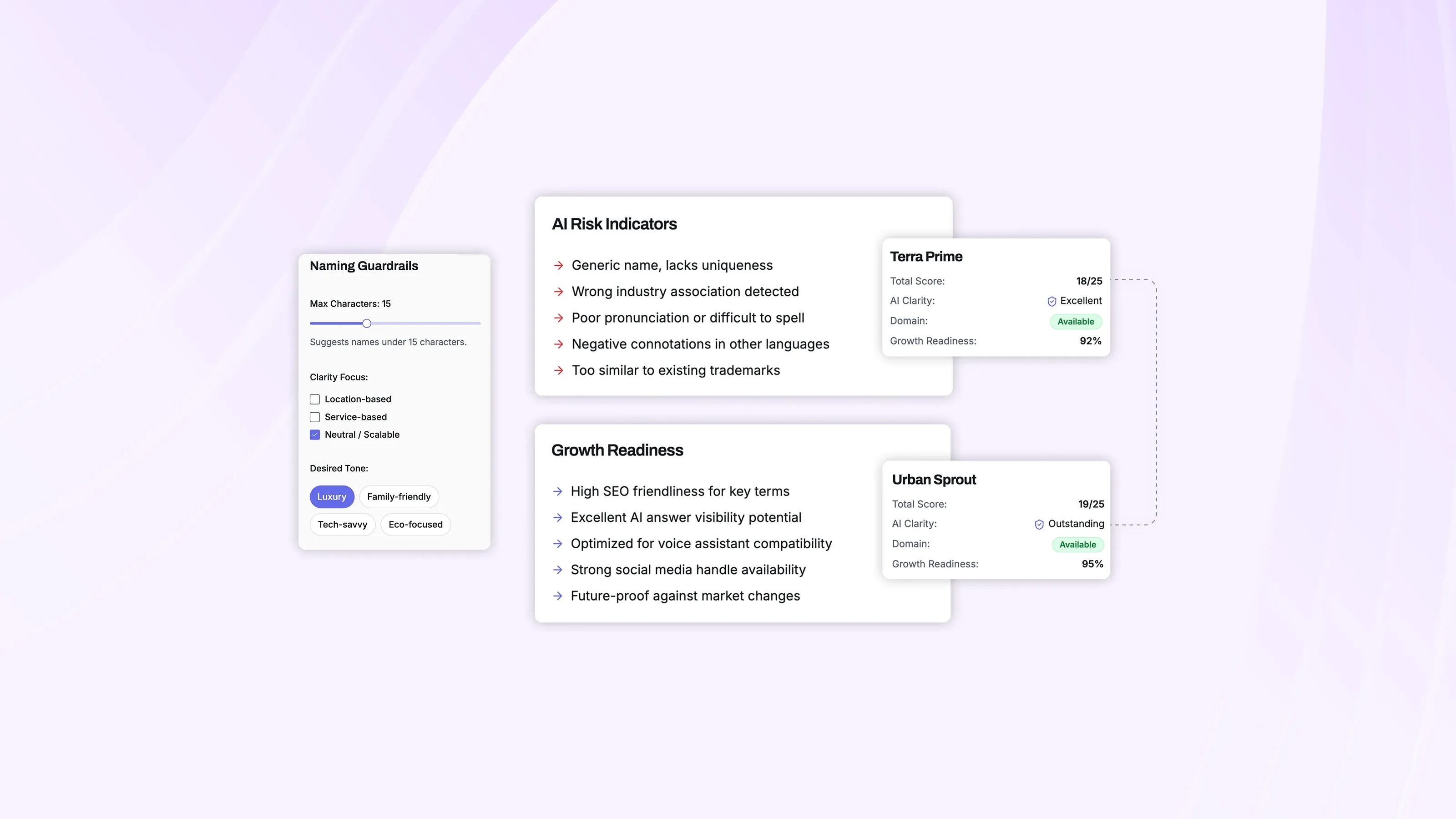
AI branding dashboard showing naming guardrails, risk indicators, and growth readiness scores for evaluating real estate brand names

Good brainstorming blends creativity with strategic filters, so you avoid names that look clever on paper but flop in search results.

Set guardrails before you riff

Before you dive into ideas, it helps to set a few simple rules so your creativity stays focused.

Keep these in mind as you brainstorm:

  • Length: Aim for 2–3 short words, under 15 characters if possible.

  • Clarity: Include a hint of your niche (“Urban Loft Group”) or service (“Equity Home Buyers”).

  • Tone: Decide on luxury, family-friendly, tech-savvy, or eco-focused.

Proven idea-generation exercises

Before you settle on a final name, play with ideas and explore different angles.

These simple exercises can help spark fresh, creative options:

  • Word dump: List 50 terms tied to location, architecture, trust, or speed.

  • Mash-ups: Combine two words (Skyline + Haven = “SkyHaven”).

  • AI co-creation: Ask ChatGPT to propose synonyms, then tweak.

  • Thesaurus loop: For each appealing word, find 5 more related options.

Mini Case-Study: How One Small Name Change Unlocked Big Growth

Compass launched in 2012 as “Urban Compass.” Customers liked the navigation motif, but investors felt it boxed them into city markets. Dropping “Urban” kept the directional metaphor yet expanded appeal; proof that minor tweaks can unlock major growth.

Capture and score your list

Once you’ve got a solid list of ideas, it’s time to narrow them down.

Create a simple table with columns for:

  • Memorability (1–5)

  • Pronunciation ease

  • Domain availability (.com matters most for global reach)

  • AI real estate branding potential (do bots understand what you do?)

  • Emotional punch

Cull any option scoring under 15 out of 25. You’ll end with 5–7 serious contenders.

A structured brainstorm not only sparks creativity but also aligns your process with data-driven decision-making. Get inspiration from Brand Building: Smart & Simple, a platform that helps streamline your branding efforts and uncovers breakthrough strategies for any brand challenge.

Testing and Validating Your Shortlist

Now stress-test those finalists so you avoid costly rebrands down the road.

Quick legal check

Start with a USPTO or local trademark database search. Eliminate anything identical or phonetically similar to an existing real estate broker in your region.

  • Use TESS (US), EUIPO (Europe), or equivalent.

  • Consult an attorney if marks appear “dead”; they may still create confusion.

  • Verify social handles on Instagram, Facebook, LinkedIn.

Finish this step and you’ll dodge cease-and-desist letters that can derail a launch.

AI visibility check

Modern branding lives inside large language models (LLMs). Ensure your name can be distinguished, pronounced, and classified correctly. Run each name through ChatGPT and Gemini. Ask, “What type of company might ‘PeakVista Realty’ be?” If the answer is wildly off (“sounds like a hiking gear brand”) - reconsider.

Platforms like Snoika can track whether your entity appears in AI answers and suggest tweaks that strengthen those signals. For more on this, read Get Your Brand mentioned by AI Search Engine to see how to optimize your brand’s presence across modern AI-powered search.

Consumer and colleague feedback

Start by running a simple one-question poll asking, “Which name feels most trustworthy for a real estate firm?” Share it with clients, partners, and friends so you get honest feedback from different perspectives. As you review the responses, listen to how people actually say the names. If a few of them struggle to pronounce one, it’s probably not the right choice.

Stress test for future growth

Imagine your firm expands into mortgage loans or vacation rentals. Does the name still fit? “Condo Kings” boxes you in; “Keyline Property Group” leaves room.

When you can check every box (legal, AI clarity, domain, and longevity) you’ve found your winner.

Polishing and Launching the Chosen Name

Once you pick a name, lock down your assets quickly.

You should:

  • Register the .com, .co, and .ai domains.

  • File trademark paperwork.

  • Grab social handles even if you won’t post right away.

  • Update Google Business Profile, Zillow Premier Agent, and local MLS records on the same day to avoid citation drift.

Lastly, feed structured data - schema markup, consistent NAP (Name, Address, Phone) - to your website. This simple step helps bots match your new name with reviews and listings, reinforcing your ai real estate branding from day one.

To keep your broader brand strategy on target, including post-launch messaging and search optimization, delve into How to Develop a Winning Brand Strategy in 2025 for practical, AI-driven branding advice.

Measuring Success Post-Launch

Give your name 90 days in market, then analyze:

  • Search impressions for brand keywords.

  • AI chat mentions (Snoika or similar tools show if GPT recommends you).

  • Lead conversion rates; remember that agents lose $14,382 annually when leads go cold. A clear name plus AI lead routing can recover much of that revenue.

  • Productivity metrics, as 85% of agents report AI boosts output; your new, AI-friendly name should amplify that effect.

For specific tactics on tracking brand visibility, search trends, and real-world KPIs, check How to Develop a Winning Brand Strategy in 2025 for the latest on measuring branded search volume, direct traffic, and more.

Improving on any of these KPIs means your naming strategy worked. For ongoing growth and brand cohesion, Brand Building: Smart & Simple offers action plans and strategy systems that evolve with your business.

Conclusion

A great real estate business name sits at the crossroads of creativity, legality, and AI comprehension. By brainstorming within clear guardrails, validating each option through legal and machine-learning lenses, and monitoring post-launch performance, you position your brand to rank higher, convert more leads, and stay memorable for years. For step-by-step branding systems and visibility insights, use platforms like Real Estate Advertising That Moves the Market and Brand Building: Smart & Simple. For trend-driven insights and robust KPIs tracking. Use the checklist above and you’ll avoid common pitfalls while making a name that resonates from the MLS to the latest AI chat interface.

Two to three short words (under 15 characters total) hit the sweet spot for memorability, domain availability, and clear voice-assistant pronunciation.

Not always. If your marketing clearly states your service, a distinctive word plus “Group” or “Properties” can stand out. However, adding the keyword can help early SEO if your brand is completely new.

Consider adding a modifier like “group,” “homes,” or your city, then secure the .com. Secondary TLDs (.co, .ai) are fine for landing pages but .com still builds the most trust.

They pull from structured data, online citations, and user conversations. Publish consistent NAP information, add schema markup, and appear on reputable sites so LLMs can connect the dots.

Yes, but expect costs: new signage, updated licenses, and potential SEO turbulence. Follow the same testing checklist, redirect old URLs, and notify clients early to minimize confusion.

Schedule a Meeting

Book a time that works best for you

You Might Also Like

Discover more insights and articles

Diagram comparing traditional SEO checklists with AI-powered SEO workflows, highlighting automation, content performance tracking, keyword trend analysis, and continuous optimization loops.

Web Page SEO Checker Guide: Optimization For ChatGPT With AI Search Citations

In this article, we examine how search engines are evolving into generative answer models and setting new technical requirements for website visibility. We also discuss how this shift requires evaluating structured data, entity relationships, and fact density to ensure content remains accessible to machine-learning algorithms.

Diagram comparing traditional SEO checklists with AI-powered SEO workflows, highlighting automation, content performance tracking, keyword trend analysis, and continuous optimization loops.

Integrated Strategy For SEO: Unite Traditional Rankings With AI Search Visibility (2026 Framework)

In this article, we explain how to build a unified framework that aligns traditional search rankings with artificial intelligence visibility. We explore the architectural shifts and measurement strategies necessary to satisfy both human readers and generative engines while avoiding duplicated organizational efforts.

Diagram comparing traditional SEO checklists with AI-powered SEO workflows, highlighting automation, content performance tracking, keyword trend analysis, and continuous optimization loops.

Generative Visibility: SEO Optimization Tools For LLMs

In this article, we discuss the changing landscape of search engine algorithms and how generative artificial intelligence platforms impact digital marketing strategies. We analyze the technical adjustments necessary to maintain brand prominence when users rely on conversational interfaces for answers instead of traditional search results.

Infographic comparing traditional SEO metrics with AI search visibility, showing shifts toward generative engine optimization, model presence, brand citations, and AI-driven visibility scoring.

SEO Ranking Checker Selection: AI Search Visibility Guide 2026

In this article, we examine the shift from traditional position tracking to visibility measurement across AI platforms. We detail the methodology for tool selection to monitor brand citations and model share accurately.